Twenty fetal monitoring myths that won’t go away

Myths about fetal heart rate monitoring are plentiful. Here are twenty of them. Let me know if there are others you would like to see me tackle!

Myths about fetal heart rate monitoring are plentiful. Here are twenty of them. Let me know if there are others you would like to see me tackle!

In 2023, Australia recorded 218,099 births, with a rising cesarean section rate, now exceeding 40%. Induction rates and maternal age increased, while the perinatal mortality rate also rose to 11.0 per 1,000. Despite efforts to enhance birth safety, outcomes show concerning trends, necessitating reconsideration of the high rates of intervention.

The evidence on CTG monitoring vs intermittent auscultation during labour does NOT prove that CTG significantly reduces stillbirth or neonatal mortality rates, in either low or high-risk populations. Professionals and academics MUST avoid misleading people about the evidence.

Continuous fetal monitoring (CFM) technologies are currently being developed for high-risk pregnancies. CFM includes monitoring fetal heart rate and movements. There are concerns about signal quality, and there is an urgent need for research to demonstrate whether CFM actually helps. What impact will it have on women and maternity professionals if it is implemented more widely?

The Dublin randomized controlled trial published in July 1985 aimed to determine the effectiveness of continuous fetal monitoring (CTG) over intermittent auscultation during labor. The trial found no significant differences in outcomes for babies. Despite its findings, CTGs remained widely used. It’s time to do something about that.
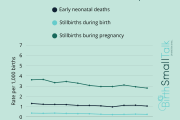
In 2023, the MBRRACE-UK report showed an 18.3% decline in birth rates since 2013 with minimal improvements in mortality rates. Despite investment in maternal care, the rate of change in perinatal mortality rates is very slow and subject to outside influences. There is a strong need for effective intervention strategies.
The design of the very first RCT about CTG monitoring is interesting, and it raised a question which we really haven’t ever answered fully. Does the use of CTGs create the very problem they are meant to prevent?

Today’s post reflects on a 1959 trial concerning “fetal distress”. It highlights findings that meconium was a critical indicator of poor outcomes, while abnormal fetal heart rates weren’t reliably predictive. Should we be reevaluating current obsessions with CTG use and focusing on alternative clinical markers?

This week I explore flawed beliefs in the effectiveness of fetal monitoring technology through a circular argument. It highlights three steps: assuming success when bad outcomes don’t occur, blaming individuals when they do, and declaring some cases unavoidable. It’s time the research to settle this was done.
Does CTG misinterpretation harm babies? Or is something else going on?
 Birth Small Talk