Does CTG monitoring work for women with risk factors?
Today’s post shares the back story behind our paper. #CTG #EFM #PerinatalMortality #CP
@TransformingMCC
@ProfJennyGamble
@MarySidebotham
@GriffithMidwifery

Today’s post shares the back story behind our paper. #CTG #EFM #PerinatalMortality #CP
@TransformingMCC
@ProfJennyGamble
@MarySidebotham
@GriffithMidwifery

Words have power. I know this – the approach I used for my doctoral research requires you to look closely at how language shapes the social world. If you have hung around the birth world for a bit, you have probably made some conscious choices about whether you use the words “patient” and “delivery”. I spend most of my working week choosing which words work best to get the job […]

Last week I published a post about why I’m not on a guideline writing group. I mentioned that I sometimes provide anonymous gentle suggestions for people who are working on fetal monitoring guidelines about how to make theirs better. You might like to get a copy of the fetal monitoring guideline where you work / where you support women to birth / where you plan to birth and read the […]

One of the problems I see over and over again is the over simplification of complexities in relation to fetal heart rate monitoring in labour. Education and clinical guidelines tend to produce what appear to be logical and straightforward explanations and advice when there is a lot of mud in the pond. Here are two examples: In both of these cases the situations are much more complicated (like this and […]

If you wouldn’t use runes to decide whether to do a cesarean section, why would you use a #CTG?

I’m not saying the goal of shared decision making is inherently wrong – it’s simply too little and too late.

All aspects of maternity care arise as consequences of the decisions that imperfect humans make, often structured by imperfect guidelines, derived from an imperfect or absent research base.

CTG monitoring is often recommended for women with higher BMI. What does the evidence say?

The problem with guidelines is not that they exist nor that they play a role in structuring good practice. The problem is when guidelines over-reach their purpose.
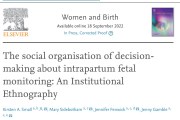
Myself and my co-authors have a new paper, freshly published with Women and Birth (available here). One of the questions I asked while generating data from my doctoral research was – who made the decision about the approach to fetal heart rate monitoring that any individual woman would use during her labour? At first glance, the answer seemed to be that no one was actively making decisions. I didn’t interview […]
 Birth Small Talk