
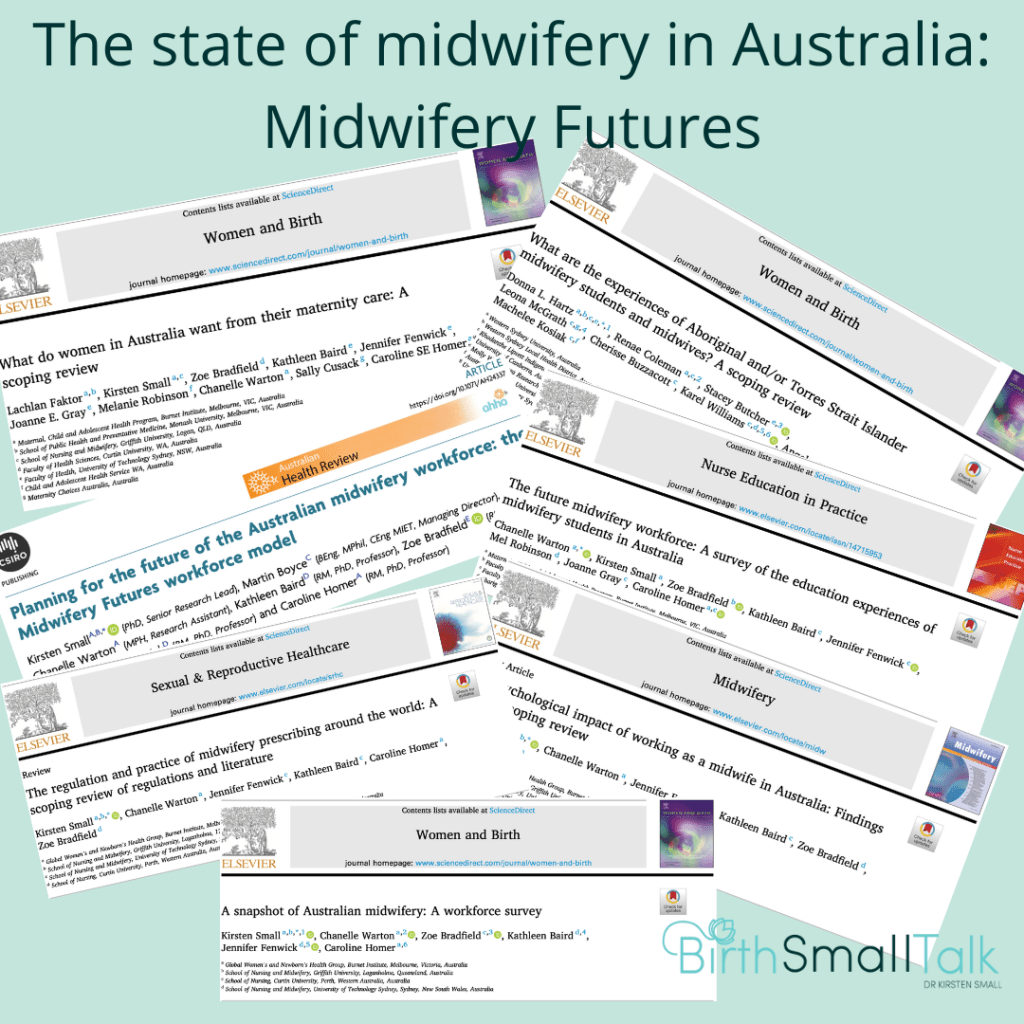
Last year, I was the Senior Research Lead for the Midwifery Futures project. Funded by the Nursing and Midwifery Board of Australia, the project examined the state of midwifery in Australia and made recommendations on how to address the issues identified. I had the pleasure of working with amazing midwifery leaders: Professor Caroline Homer, Professor Zoe Bradfield (current president of the Australian College of Midwives), Professor Jennifer Fenwick, Professor Kathleen Baird, and Professor Joanne Grey; along with Aboriginal nurse Melanie Robinson, and research assistant Chanelle Warton. So many other people were also instrumental in the success of the project, and I won’t name them all here (though you can find them all in the Midwifery Futures report).
While the report was released late year, it has taken a little bit longer to gently nurse all the publications from the project through the peer review process. We are there at last! All the papers are published as Open Access, so you can read the full paper without paying a licence fee. Here is a short summary of each of the publications.
What do women want from their maternity care?
This scoping review was lead by Lachlan Faktor. He was a final year medical student at the time and had now begun his medical career. The review included 59 Australian papers. We found that women wanted to be seen and heard, to be safe (physically, emotionally, and culturally), and to be enabled through effective communication and information sharing to make decisions about their care. The overarching theme was continuity of care – as all these goals were easiest to achieve in the context of a relationship with their care provider.
A short summary of this paper was also published by MJA Insight.
What are the experiences of Aboriginal and /or Torres Strait Islander midwives and midwifery students in the Australian maternity care system?
This scoping review was lead by Professor Donna Hartz and was conducted by a team of Indigenous midwifery researchers. They found eleven papers to include, the small number reflecting the urgency of the need for more research in this area. They reported on three interconnected themes of connection and kinship, experiences of racism, and the challenge of balancing family, community, and professional responsibilities. The paper provides recommendations for ways to better support midwifery students and midwives and to address racism.
What is it like to be a midwifery student?
This paper reported on the Midwifery Futures survey of current and recently graduated midwifery students, with 303 people providing survey responses. Most students considered that their education was preparing them well for midwifery practice. However, the work of being a student was challenging, with more than half reporting they had considered withdrawing from their program at some point. The challenges included the financial cost of study, and the difficulty of meeting some of the mandatory requirements of the degree – such as continuity of carer experiences. Working in a midwifery continuity of carer model on graduation was preferred by 80% of respondents, with only 33% wanting to work full time. Students commitment to and satisfaction from working in midwifery was clear from the written comments, with one student writing:
I’ve wanted to be a midwife for most of my life and it still gives me goosebumps and I don’t want to go home. I’m still enjoying the role even with all the difficulties.
p9, Grad Dip Mid Year 1, Victoria
Modelling the future midwifery workforce
We worked closely with Martin Boyce from Novametrics on this one (he and his team are also responsible for the modelling in the State of the World’s Midwifery Report). I really enjoyed this collaboration. Martin produced a very complex and data rich Excel spreadsheet that allowed us to manipulate one factor at a time (like numbers of new graduated entering the profession, or attrition) to see what the impact on workforce adequacy would be. It filled my nerdy research brain with delight!
We found that if current levels of midwives entering and exiting the system remain the same – then there will continue to be enough midwives overall for the foreseeable future (though we recognise that midwives are not equitably distributed across all areas of Australia). However, even a small increase in attrition rates would be profoundly and rapidly devastating. This demonstrated that the midwifery workforce in Australia is not resilient to change.
The psychological impact of working as a midwife in Australia
This was another one of our scoping reviews. As our team explored the range of literatures about issues affecting the Australian midwifery workforce, we could see that a large body of research about the psychological impact of midwifery work had been generated, but had never been summarised in the one place. We analysed 26 papers, nine examined burnout, two depression and anxiety, six measured professional satisfaction, one empowerment, two bullying in the workplace, five trauma, and one reported on moral distress.
The findings make for pretty grim reading. While most midwives (85% in one survey) found their work satisfying, rates of personal (up to 68% of midwives) and work-related burnout (up to 57%) were high. Most midwives had experienced or witnessed workplace bullying, and 85% reported having been exposed to traumatic birth events in their professional capacity. Working in continuity of carer models, and being able to provide quality care aligned with midwifery philosophy were protective factors.
Midwifery prescribing around the world
This paper set out to explore the state of midwifery prescribing in high-income English speaking countries, to better understand how Australian midwifery prescribing is positioned. We looked at both regulatory standards and research publications. In New Zealand, the Canadian states of British Columbia and Ontario, and the states of Virginia and New Mexico in the USA, midwives are granted prescribing authority at the completion of their primary midwifery qualification. Australian, the UK, and Ireland require midwives to complete another course or qualification to be granted prescribing authority.
We found that there has been a move towards more autonomy for midwives to prescribe over time, birth in Australia and elsewhere. There was evidence that midwifery prescribing improved women’s access to appropriate healthcare, and was a well embedded practice in countries who were early adopters of midwifery prescribing. During the process of publication, one of the remaining Australian states that limited midwives to prescribing from a narrow list of options was overturned, and we are also waiting on the outcome of consultations to be conducted by the NMBA to see if the registration standards can be altered to make it easier for midwives to become prescribers.
A snapshot of Australian midwifery
The Midwifery Futures workforce survey is the largest survey of the Australian midwifery workforce that has been conducted to date, with 3,286 midwives providing data. Worryingly, 37% of midwives were considering leaving midwifery (and given what we know from our modelling data this would be absolutely catastrophic for maternity care provision if this were to happen). Many reported poor workplace cultures, understaffing, over-medicalisation, and being unable to provide safe care.
Part time work was common. Only 12% of midwives were working in roles where they might provide continuity of care, yet 37.5% of midwives expressed their preference to work in midwifery group practice. There is clearly untapped potential to offer more women access to continuity of carer.
The impact of working in continuity of carer models
And the final paper is this scoping review, exploring Australian literature relating to the impact that working in a continuity of carer model has on midwives. Midwives working in continuity of carer models reported positive working relationships with the women in their care, improved professional satisfaction, and lower rates of burnout, depression, and anxiety. While some midwives enjoyed the flexibility of working in an on call model and found this improved family life, this was not the case for all.
We were unable to account for differences in the way the specific models were implemented. This included on call arrangements. Further research is needed to identify model designs that best support midwives working in continuity of carer models.
Sign Up for the BirthSmallTalk Newsletter and Stay Informed!
Want to stay up-to-date with the latest research and course offers? Our monthly newsletter is here to keep you in the loop.
By subscribing to the newsletter, you’ll gain exclusive access to:
- Exciting Announcements: Be the first to know about upcoming courses. Stay ahead of the curve and grab your spot before anyone else!
- Exclusive Offers and Discounts: As a valued subscriber, you’ll receive special discounts and offers on courses. Don’t miss the chance to save money while investing in your knowledge development.
Join the growing community of BirthSmallTalk folks by signing up for the newsletter today!
Sign up to the Newsletter

References
Faktor, L., Small, K., Bradfield, Z., Baird, K., Fenwick, J., Gray, J. E., Robinson, M., Warton, C., Cusack, S., & Homer, C. S. (2024, Mar). What do women in Australia want from their maternity care: A scoping review. Women & Birth, 37(2), 278-287. https://doi.org/10.1016/j.wombi.2023.12.003
Hartz, D. L., Coleman, R., Butcher, S., McGrath, L., Buzzacott, C., Williams, K., Coe, A., & Kosiak, M. (2025, Jan). What are the experiences of Aboriginal and/or Torres Strait Islander midwifery students and midwives? A scoping review. Women & Birth, 38(1), 101856. https://doi.org/10.1016/j.wombi.2024.101856
Hobday, M. B., Fenwick, J., Reynolds, J., Small, K., Warton, C., Robinson, M., Homer, C. S. E., Gray, J., Baird, K., & Bradfield, Z. (2025). Impact of working in continuity of care models on Australian midwives: A scoping review. Women and Birth, 38(4). https://doi.org/10.1016/j.wombi.2025.101932
Homer, C., Small, K., Warton, C., Bradfield, Z., Fenwick, J., Gray, J., & Robinson, M. (2024). Midwifery Futures: Building the future Australian midwifery workforce. https://www.nursingmidwiferyboard.gov.au/News/Midwifery-Futures.aspx
Small, K., Boyce, M., Warton, C., Baird, K., Bradfield, Z., Fenwick, J., & Homer, C. (2025, May 13). Planning for the future of the Australian midwifery workforce: the Midwifery Futures workforce model. Australian Health Review, 49, AH24337. https://doi.org/10.1071/AH24337
Small, K., Faktor, L., Cusack, S., Bradfield, Z., Warton, C., & Homer, C. (2024, April). What women want from their maternity care. MJA Insight. https://insightplus.mja.com.au/2024/12/what-women-want-from-their-maternity-care/
Small, K., Warton, C., Bradfield, Z., Baird, K., Fenwick, J., & Homer, C. (2025). A snapshot of Australian midwifery: A workforce survey. Women and Birth, 38(4). https://doi.org/10.1016/j.wombi.2025.101928
Small, K., Warton, C., Fenwick, J., Baird, K., Bradfield, Z., & Homer, C. (2025, May). The psychological impact of working as a midwife in Australia: Findings from a scoping review. Midwifery, 145, 104377. https://doi.org/10.1016/j.midw.2025.104377
Small, K., Warton, C., Fenwick, J., Baird, K., Homer, C., & Bradfield, Z. (2025). The regulation and practice of midwifery prescribing around the world: A scoping review of regulations and literature. Sexual & Reproductive Healthcare, 44. https://doi.org/10.1016/j.srhc.2025.101109
Warton, C., Small, K., Bradfield, Z., Baird, K., Fenwick, J., Robinson, M., Gray, J., & Homer, C. (2025, Mar). The future midwifery workforce: A survey of the education experiences of midwifery students in Australia. Nurse Education in Practice, 84, 104321. https://doi.org/10.1016/j.nepr.2025.104321
- How intermittent auscultation is done in the UK
- Perinatal outcomes in the UK: Update from the MBRRACE-UK report
Categories: New research
Tags: Aboriginal, Attrition, Burnout, Continuity of care, Midwifery, Midwifery Students, Modelling, Survey, Torres Strait Islander
 Birth Small Talk