
With thanks to Maryann Long, CNM, PhD, for bringing Lisa Paine’s work to my attention.
I’m always fascinated about how some new ideas “stick” and are incorporated into practice, while others fall by the wayside. Despite having read widely about fetal heart rate monitoring options for the past decade, the Auscultated Acceleration Test never crossed my path. This simple approach seems to have fallen by the wayside. I want to bring wider awareness to it as a viable option for antenatal fetal monitoring. Over the next few weeks, I’ll take you through what is known about it.
So what are we talking about here?
The Auscultated Acceleration Test (AAT) was developed by certified nurse-midwife Lisa Paine as an alternative to antenatal CTG monitoring (also called the non-stress test, particularly in North America). She describes the AAT as (Paine & Johnson, 1986, Part II) –
- Listening to the fetal heart rate with an Allen fetoscope
- The heart rate was counted in five second increments, mentally noting an increase or decrease in the fetal heart rate, with the next five seconds used to document that number, before listening again
- If an increase (an acceleration) was heard, this was taken to be a sign of good fetal health
- If an increase was not heard, the midwife would palpate the fetus and gently shake it in utero, to stimulate fetal movement
- The fetal heart rate counting was repeated after this was done, again looking for an acceleration, providing reassurance of fetal wellbeing
- If no accelerations were auscultated over a five minute period including after fetal stimulation had been performed, the woman was referred for obstetric review and CTG monitoring
The Allen fetoscope merges the cone shaped end of the Pinard fetoscope with the tubing and “in both ears” listening typical of a standard stethoscope. The precise device is not important here however, as the same principles apply irrespective of the device used to determine the heart rate. Most modern handheld Doppler based devices feature a screen displaying a calculated heart rate count, avoiding the need to mentally count the number. Without this, it makes sense to count repeatedly for shorter periods. Counting for a full sixty seconds averages out any variability in the heart rate, and fails to account for any accelerations or decelerations, as only one single number is generated and documented. These are the details you need to determine fetal wellbeing, so finding a way to capture them is valuable.
How do you document what you hear?
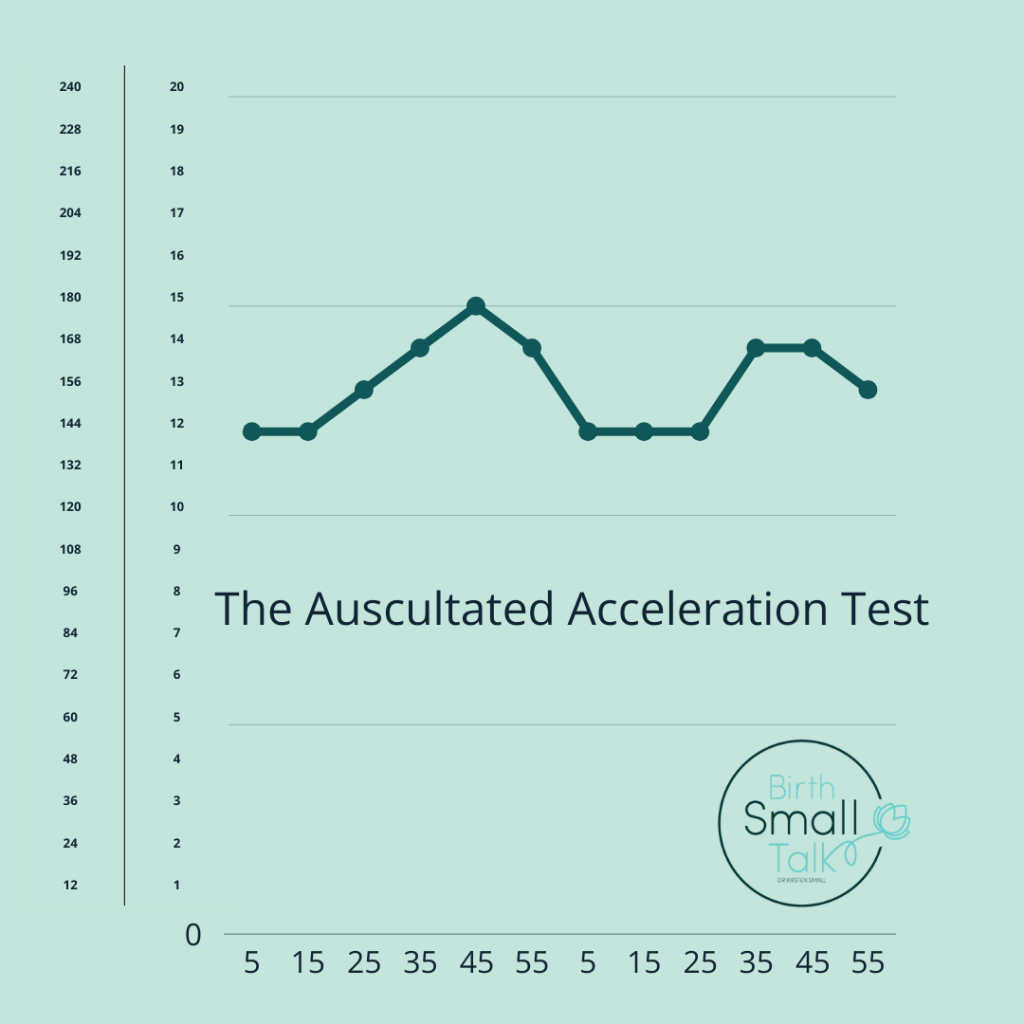
In her other paper (Paine et al., 1986, Part 1), Paine explained the approach she developed to documenting these findings. She developed a graph, with time in five second blocks along the X axis and the heart rate along the Y axis, given as both the count in five seconds, and also what this corresponds to over a full minute. Each five seconds, a dot is placed on the graph to show the count at that point in time. The alternate five second block is left blank (as this is the time used for this documentation).
The end result is a heart rate pattern that looks very CTG like. It makes it possible to visualise accelerations and decelerations. There is also a suggestion of what the variability is, although this is far less fine grained than the way it appears on a CTG. Paine includes several completed graphs in her paper. Copyright prevents me from sharing these, so I have generated something similar to use as the image for this post.
Interesting!
This approach seems to formalise what many people do in practice, with a clear way to document and visualise the findings. I’m keen to know if you do something a bit like this, and what variations on this approach exist. Let me know in the comments!
Paine and other researchers have evaluated the AAT and I’ll be sharing the findings of that research over the next few weeks.
Sign Up for the BirthSmallTalk Newsletter and Stay Informed!
Want to stay up-to-date with the latest research and course offers? Our monthly newsletter is here to keep you in the loop.
By subscribing to the newsletter, you’ll gain exclusive access to:
- Exciting Announcements: Be the first to know about upcoming courses. Stay ahead of the curve and grab your spot before anyone else!
- Exclusive Offers and Discounts: As a valued subscriber, you’ll receive special discounts and offers on courses. Don’t miss the chance to save money while investing in your knowledge development.
Join the growing community of BirthSmallTalk folks by signing up for the newsletter today!
References
Paine, L. L., Payton, R. G., & Johnson, T. R. (1986). Auscultation fetal heart rate accelerations. Part I. Accuracy and documentation. Journal of Nurse-Midwifery, 31(2), 68-72.
Paine, L. L., & Johnson, T. R. (1986). Auscultated fetal heart rate decelerations. Part II. An alternative to the nonstress test. . Journal of Nurse-Midwifery, 31(2), 73-77.
Categories: antenatal CTG, IA
Tags: AAT, acceleration, Lisa Paine, Non-stress test
4 replies ›
Trackbacks
- Are midwives accurate? The AAT Part 2. – Birth Small Talk
- Can the AAT predict outcomes as well as antenatal CTG use? – Birth Small Talk
 Birth Small Talk
After reading this information, I created a kinda-sort-a excel spreadsheet to document and graph instantly. (I mean kinda-sort-a because I’m no techno-wizz.) I’m going to try it out!
LikeLike
Report back Vivienne – I’d love to hear how the experiment goes
LikeLike