
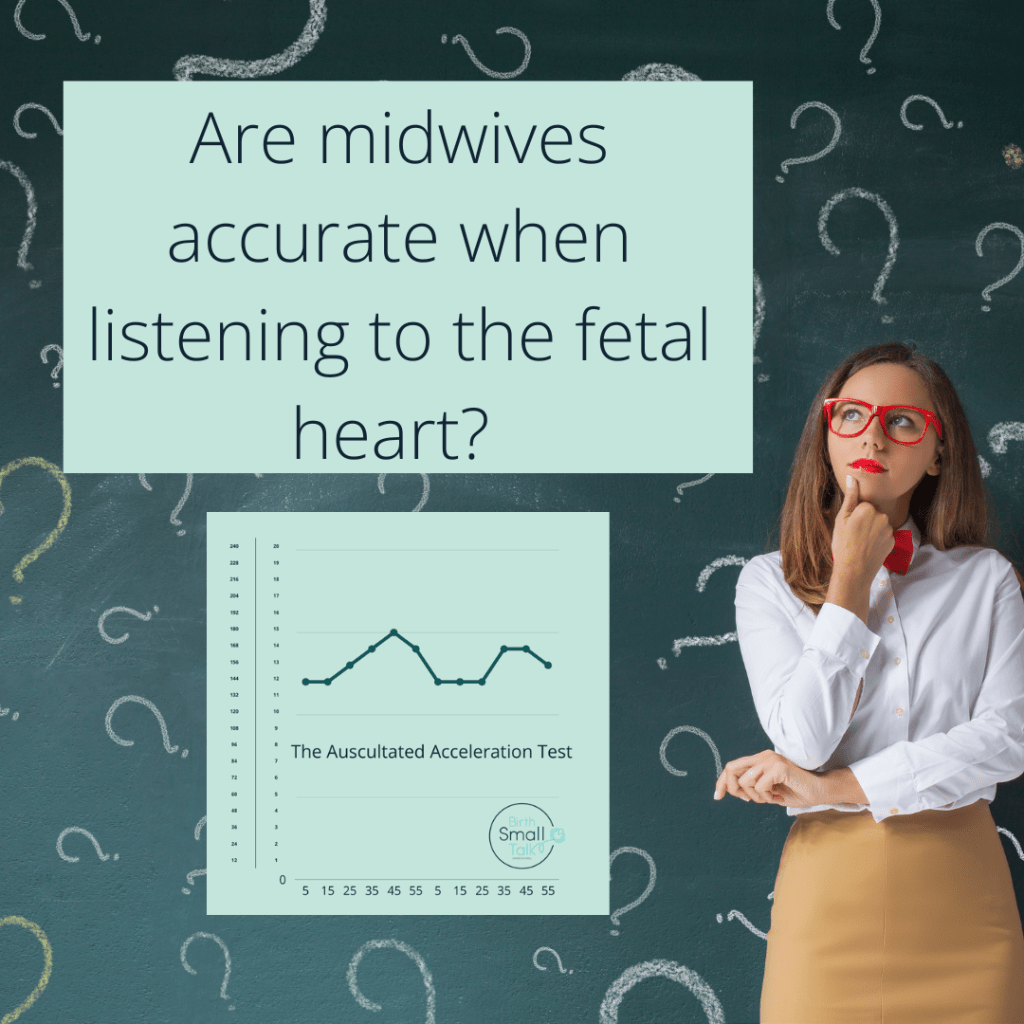
Last week I explained what the AAT was. This week I want to share research that compared one midwife against another, to see if they were able to generate an accurate assessment of the fetal heart rate pattern, and were able to detect accelerations as reliably as a CTG machine. If you missed last week’s post and don’t know what I’m talking about – you can find it here.
How was the research done? Study 1.
There are two studies to look at. The first research was conducted in 1986 by Lisa Paine, Ruth Payton, (certified nurse midwives), and Timothy Johnson (a perinatologist). Three women were recruited to assist with the research. Each was at least 34 weeks pregnant, and had a singleton pregnancy. Two certified nurse-midwives simultaneously listened to the fetal heart rate for 15 seconds, and they did this ten times. An Allen fetoscope was used. Unlike modern Dopplers, the sound is not audible unless you have the earplugs in your ears. Every 15 seconds, the two midwives reported the heart rate they heard to an observer who wrote the numbers down. Correlation coefficients were calculated, providing a statistical assessment of how similar the results were.
In the second part of the research, 29 women, all at least 34 weeks pregnant with a single fetus had a period of CTG monitoring (a non-stress test). The women consented to have one certified nurse-midwife simultaneously auscultate the fetal heart with an Allen fetoscope. The audio output from the CTG was turned off. The heart rate count every five seconds for up to six minutes, stopping when an auscultation was heard. The auscultated heart rate was recorded graphically, and both this record and the corresponding segment of the CTG recording were reviewed by the perinatologist author who assessed how accurately the accelerations were recorded in relation to the CTG trace.
How was the research done? Study 2
Daniels and Boehm (both certified nurse-midwives) reported their findings in 1991. They set out to replicate the second part of Paine’s original research in a larger population – with 132 non-stress tests performed for 148 women. Once again, all were at least 34 weeks with a single fetus, and the reasons why non-stress testing was being used were similar.
What did they find?
Midwives achieved a high degree of accuracy in their counting of the fetal heart rate. The largest difference in count in a 15 second period was four beats – one reported a count of 39 beats and the other 35. Out of the total of 30 periods of listening (10 for each woman) there were only five where the heart rate differed by more than one beat in the 15 second period (equivalent to more than four beats per minute). Correlation coefficients were high at 0.8, 0.9, and 0.8 for the three women.
For the second approach – comparing the AAT to the CTG, Paine found that accelerations in the fetal heart rate were accurately detected by the AAT for 28 of the 29 women (an accuracy rate of 97%). Examples of both the AAT graph and the CTG are provided in the paper – and the similarity between the two is striking. Both are provided for the one case where accelerations were said to be present on the CTG but were not detected by the AAT. The quality of the image is poor – but it appears there were two periods of loss of contact coinciding with fetal movements. The CTG picks up just a few beats at a much higher rate than the baseline in the middle of this period of loss of contact. It is this that has been interpreted as an acceleration. I would actually call this a poor quality and therefore uninterpretable CTG – reflecting the greater attention to trace quality that is now a feature of practice.
Daniels and Boehm had similar findings – with a high rate of agreement between the AAT and the non-stress test. There were no false negatives in their study – meaning that all women with a non-reassuring non-stress test also had a non-reassuring AAT. Likewise, all women with a reassuring AAT had a reassuring non-stress test.
What does this mean?
There is a widespread belief that intermittent auscultation simply isn’t as accurate as a CTG, with some claiming that all you can reliably determine is the baseline and no other features of the heart rate pattern. This clearly wasn’t the case in this research. By way of comparison, the highest correlation coefficients comparing the difference between one person reading a CTG or another person reading the same CTG in labour, and determining whether an acceleration was present found in a recent review of this literature was 0.85 (Engelhart et al., 2023, S9). For assessment of the baseline, it was 0.98, with typical results around 0.7 (Engelhart et al., 2023, S6). The measure of agreement seen with the AAT is similar to, or marginally better than this.
In both these studies the AAT performed equally well as the CTG monitoring. It is a quicker test (five minutes rather than 15-20 minutes) and does not require additional technology that many midwives may not have access to outside of the hospital setting. It would perform well as a first line screening test – with women with non-reassuring tests referred on for further assessment.
Modern handheld Doppler technology makes it easier to hear the fetal heart beat, and uses some of the same technology built into CTG machines to produce a number on the screen, showing the moment-by-moment heart rate count. It is therefore likely to be even more accurate than the readings produced with the Allen stethoscope. It would be really useful to have some up to date research comparing the accuracy of intermittent auscultation with a Doppler and a CTG, both in pregnancy and during labour.
Stay tuned for next week – when I’ll take you through research looking at how well the AAT predicted poor outcomes.
Sign Up for the BirthSmallTalk Newsletter and Stay Informed!
Want to stay up-to-date with the latest research and course offers? Our monthly newsletter is here to keep you in the loop.
By subscribing to the newsletter, you’ll gain exclusive access to:
- Exciting Announcements: Be the first to know about upcoming courses. Stay ahead of the curve and grab your spot before anyone else!
- Exclusive Offers and Discounts: As a valued subscriber, you’ll receive special discounts and offers on courses. Don’t miss the chance to save money while investing in your knowledge development.
Join the growing community of BirthSmallTalk folks by signing up for the newsletter today!
References
Daniels, S. M., & Boehm, N. (1991). Auscultated fetal heart rate acclerations: An alternative to the non-stress test. Journal of Nurse-Midwifery, 36(2), 88-94.
Engelhart, C. H., Brurberg, K. G., Aanstad, K. J., Pay, A. S. D., Kaasen, A., Blix, E., & Vanbelle, S. (2023, Jun 13). Reliability and agreement in intrapartum fetal heart rate monitoring interpretation: A systematic review. Acta Obstetrica et Gynecologica Scandinavica. https://doi.org/10.1111/aogs.14591
Paine, L. L., Payton, R. G., & Johnson, T. R. (1986). Auscultation fetal heart rate accelerations. Part I. Accuracy and documentation. Journal of Nurse-Midwifery, 31(2), 68-72.
- What is the Auscultated Acceleration Test?
- Can the AAT predict outcomes as well as antenatal CTG use?
Categories: antenatal CTG, CTG, IA
Tags: AAT, interobserver variability, Non-stress test
 Birth Small Talk