
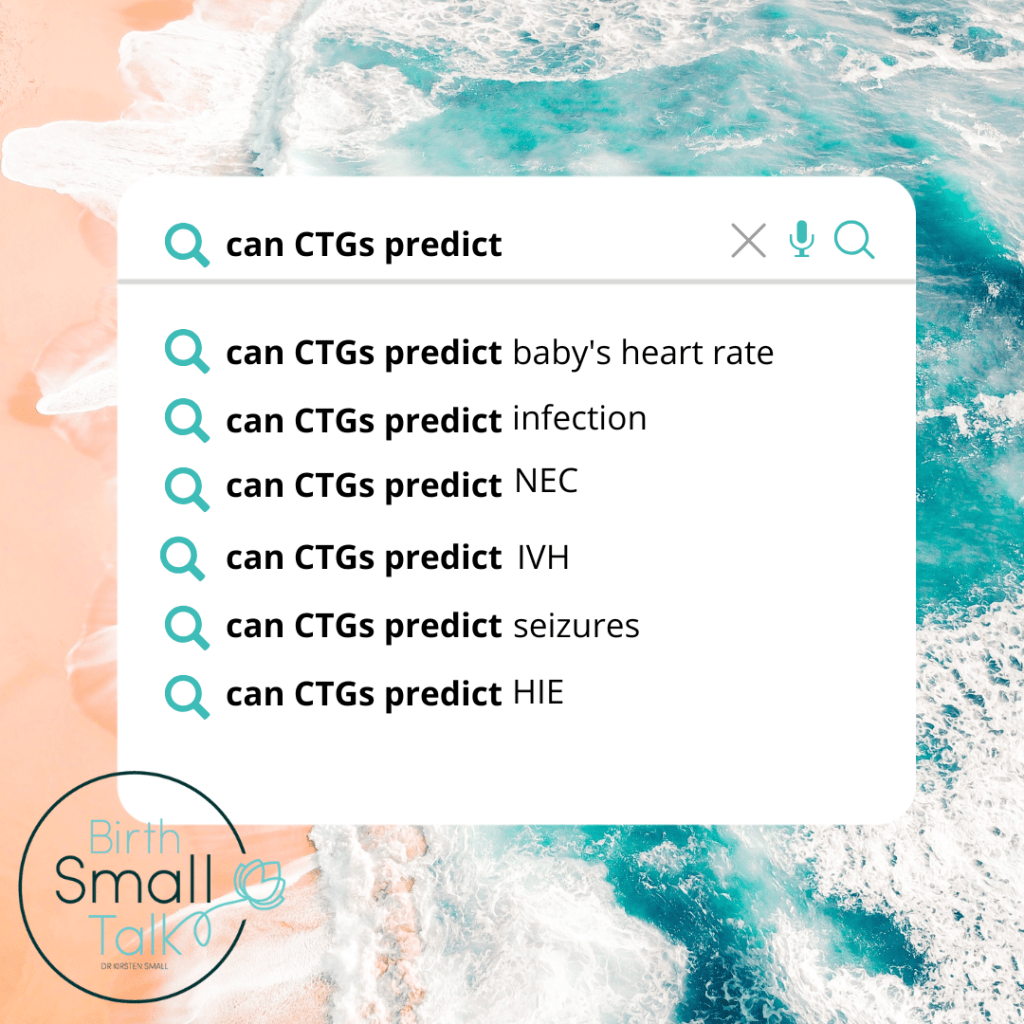
One of the arguments used to justify widespread use of CTG monitoring is that it is the best approach to identify abnormal heart rate patterns and therefore predict that the fetus is at risk for a poor outcome. A team of researchers has recently published a detailed review of all the research that has attempted to link abnormal heart rate patterns as seen on CTG monitoring with specific outcomes (Eenkhoorn et al., 2024). Today’s blog post explores what they found.
What did they do?
The research term searched five large databases of research, from the time each one was started, to October 2023. They looked for studies that examined the relationship between fetal heart rate patterns and any one of the following outcomes:
- Neonatal heart rate
- Neonatal infection (sepsis or pneumonia)
- Necrotising enterocolitis (a condition leading to bowel damage)
- Intraventricular haemorrhage (bleeding into the brain, sometimes due to previously low oxygen levels)
- Hypoxic ischaemic encephalopathy (HIE – signs and symptoms of brain injury due to low oxygen, and / or poor blood flow), and
- Seizures (fits, sometimes due to previously low oxygen levels).
Notably what they left off the list were things that are often measured and included in research – like Apgar scores, cord blood gas acidosis, or admission to the neonatal nursery. While these things are sometimes due to low oxygen levels in labour, there are many other reasons for them, and they are not in themselves actual pathological conditions. If a baby is born with a low Apgar score, but grows up to be a PhD qualified obstetrician who writes blogs, you can’t really call that a bad outcome! I think the authors made a good decision here. What they didn’t include, and I would have liked to see it, were deaths and cerebral palsy.
About the papers
Most of the studies (n = 23) were retrospective case-control studies. In other words, babies with one of these conditions were identified, and a copy of their CTG was examined. Babies who were born around the same time who didn’t have the condition had their CTGs examined too. Comparisons where then made about how many of the babies in each group had abnormal heart rate patterns.
The other type of research was prospective cohort studies (n = 19). A group of pregnant women are identified and followed over time. All were asked to have CTG monitoring and the researchers collected information about what the CTG trace showed. Some gave birth to babies with one of the conditions being studied and some had babies who didn’t have the problem. The CTG patterns from the two groups was compared.
The studies were published from 1975 to 2023 – spanning the entire period that CTGs have been in common use. Research teams in Africa, Asia, Europe, and North and South America all contributed research. Populations included preterm, term, post-term, and low birth weight babies. In nine studies the CTG recording that was the focus of the study was done during pregnancy, and in the other 37 it was CTG recordings from labour. Five studies had a low risk of bias, 27 had a medium risk, and 10 had a high risk. What this means is that for most of the research, there is a possibility that an apparent connection between a heart rate pattern and an outcome might be explained by something other than the heart rate pattern.
What did they find?
- Neonatal heart rate: 4 studies, 561 term infants, three compared heart rate in labour with heart rate after birth, the other didn’t specify when the first heart rate was determined. Fetuses with abnormal heart rates in labour had higher heart rates as newborn babies and were more likely to have reduced heart rate variability.
- Necrotising enterocolitis: 3 studies, 18,458 preterm infants, one looked at pregnancy CTG patterns, and two at patterns in labour. They found no relationship between abnormal heart rate patterns and necrotising enterocolitis.
- Infection: Nine studies, 27, 238 infants, three studies looked at pregnancy CTG patterns and the rest at patterns in labour. Five studies found no link between abnormal CTG patterns and infection, two found a link between antenatal CTG patterns and infection, and two found a link between labour CTG patterns and infection. The specific heart rate patterns linked to infection were tachycardia, non-reassuring and non-reactive patterns. The connections were mostly specific (a normal pattern made infection unlikely) but not sensitive (an abnormal pattern made infection likely).
- Seizures: Seven studies, 18,936 infants. One study found no connection between CTG patterns and seizures, with the others finding a link between non-reassuring patterns and seizures.
- Intraventricular haemorrhage: Eleven studies, 19,159 infants, three looked at pregnancy CTG patterns and the rest at patterns in labour. Five studies found no connection between CTG patterns and intraventricular haemorrhage. In the others, babies were more likely to have a haemorrhage if the CTG pattern had no reactivity, showed decelerations or reduced variability, was non-reassuring or ominous. The relationships between the patterns and haemorrhage were weak.
- Hypoxic ischaemic encephalopathy: Sixteen studies, 27,709 infants, two used pregnancy CTG patterns and the rest used labour patterns. All found an association between CTG patterns and HIE, with more CTGs showing reduced variability, fewer accelerations, more decelerations, and more overall abnormal recordings. The predictive abilities of the abnormal patterns was low.
If you are particularly interested – it is worth getting a copy of their paper, as the tables provide much more information than I have summarised here.
What does all that mean for CTG monitoring?
The first argument people who support CTG monitoring make, is that there is evidence that outcomes for babies are better when CTGs are used rather than intermittent auscultation. There isn’t though.
Their next fall back position is that there is a clear link between certain heart rate patterns and poor outcomes, and therefore if we can train people to (better) recognise these patterns, then CTG monitoring WILL improve outcomes. This review of the evidence shows that while, yes there is a link for some conditions, it isn’t a strong as people imagine it to be, and it probably isn’t clinically useful after all.
I think the logical conclusion is therefore to recognise that the fetal heart rate is the wrong thing to monitor in labour, and find something else that actually works. The authors of this study instead doubled down on the idea that the CTG is rescuable and all we need is a better form of artificial intelligence to identify heart rate changes that are predictive. Maybe they are right. But how long are we prepared to spend faffing about trying to find out before looking for a better alternative?
Sign Up for the BirthSmallTalk Newsletter and Stay Informed!
Want to stay up-to-date with the latest research and course offers? Our monthly newsletter is here to keep you in the loop.
By subscribing to the newsletter, you’ll gain exclusive access to:
- Exciting Announcements: Be the first to know about upcoming courses. Stay ahead of the curve and grab your spot before anyone else!
- Exclusive Offers and Discounts: As a valued subscriber, you’ll receive special discounts and offers on courses. Don’t miss the chance to save money while investing in your knowledge development.
Join the growing community of BirthSmallTalk folks by signing up for the newsletter today!
Sign up to the Newsletter

References
Eenkhoorn, C., van den Wildenberg, S., Goos, T. G., Dankelman, J., Franx, A., & Eggink, A. J. (2024, Oct 25). A systematic catalog of studies on fetal heart rate pattern and neonatal outcome variables. Journal of Perinatal Medicine, in press. https://doi.org/10.1515/jpm-2024-0364
Categories: antenatal CTG, CTG, EFM, New research, Perinatal brain injury
Tags: HIE, Infection, Intraventricular haemorrhage, Necrotising enterocolitis, Neonatal encephalopathy, Prediction, seizures
 Birth Small Talk
Should I say: Congratulations on doing so well after a poor Apgar score? Do you think your own history had any bearing on your career choices? Or is that too personal a question? (Only asking because I studied psychology in order to look into maternal deprivation – ended up investigating psychology and physiology of birth)
LikeLike
My birth as a breech (vaginally) and almost certain early cord clamping explain the Apgar score, I suspect. And possibly some of my urge to put both feet forward before my head catches up with me!
LikeLike