
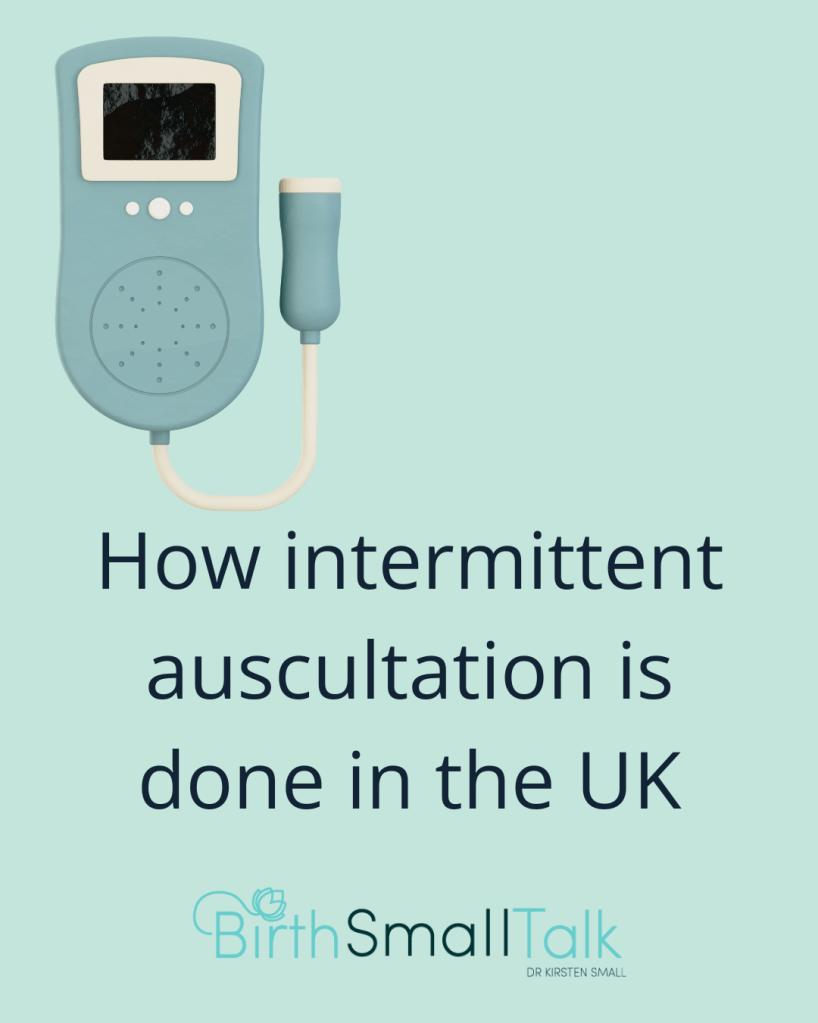
A recent piece of research, conducted as part of the Listen2Baby study in the UK, set out to describe what was going on in different birth settings in the UK when intermittent auscultation was being use. By way of context, the NHS in the UK offers four different birth settings for users of maternity care:
- Obstetric units, in hospitals, with obstetric oversight,
- Alongside midwifery units – midwifery led care options within the same premises as an obstetric unit,
- Freestanding midwifery units – midwifery led care in facilities that are not co-located with an obstetric unit, and
- Home birth services. These are again midwifery led.
CTG monitoring is only available in obstetric units, and some women in obstetric units will have intermittent auscultation for their labour. Intermittent auscultation is therefore mostly used in the other settings. While there is enough evidence to reassure us that intermittent auscultation is a safe option, there is little research to provide guidance on how and when to listen, what to listen for, how to provide education and ensure competence, and how to make use of the information gained from listening to the fetal heart rate. Understanding what people are actually doing is therefore a good starting point before providing new guidance on intermittent auscultation.
What was done?
The research team developed an online survey, that ran between November 2022 and February 2023. This was sent to 205 maternity services that contribute to the UK Midwifery Study System, and another 33 obstetric units that didn’t have a midwifery unit. The link to the survey was sent to UK Midwifery Study System midwife reporters, Heads of Midwifery, and Fetal Monitoring Lead Midwives, with a request to complete the survey about practices within that specific service. The questions covered local policy about intermittent auscultation, training and competency assessments, practice audits, the availability of devices for intermittent auscultation, and intermittent auscultation practices in the different settings in each organisation.
What they found
174 of 238 units approached provided responses. Local policy was in place in 90% of midwifery led settings and 76% of obstetric units, with no guidance in either setting in only 8% of locations. The focus of the guidance was on splitting women up into “low risk” and “high risk” categories and prescriptively allocating the type of fetal monitoring women would use on this basis. This was the response from one unit, showing what this typically looked like:
Women [in the] Obstetric Unit that are suitable for Intermittent Auscultation have Intermittent Auscultation. Women [in the] Obstetric Unit who meet the criteria for CTG have a CTG. Intermittent Auscultation guidance is only for straight- forward pregnancies meeting the criteria for the Obstetric Unit or Midwifery Unit.
Alongside midwifery unit, England
While most places had policy guidance, compulsory training in intermittent auscultation and competency assessment was less often reported: with this required in 56% of Alongside Midwifery Units, 59% of Freestanding Midwifery Units and 65% of Obstetric Units. Another 34% of Alongside Midwifery Units and 29% of Freestanding Midwifery Units had education but no competency assessment. In-house training was the case in 29% of services, another 21% used the commercial K2 perinatal training program, and most other places used the NHS eLearning package for Intelligent Intermittent Auscultation either alone or in combination with some other educational approach.
32% carried out practice audits at least annually. The details of what was audited and how was not sought, but data from free text comments showed a range of approaches from chart audits to in person peer review and observational auditing of intermittent auscultation technique.
Pinards were almost always available (96%), audio only Dopplers were the next most commonly available (87%), with number display Dopplers available in 66% of locations, those with the fetal heart rate trace displayed in 45% of locations. Pleasingly, waterproof options were almost universally available (97%). While available, Pinards were less often used than Doppler based devices – 41% of service reported the use of a Pinards for initial labour assessment, and 20% in labour. Audio only Dopplers were used the most commonly used options in labour at 77%. Admission CTGs for low risk women were never used in 71% of units and sometimes used “if clinically needed” (but what this clinical need was, was not defined) in the others, with only one unit doing these routinely for all women.
Services reported the use of a “Fresh Ears” buddy system in 48% of Midwifery units and 42% of Obstetric Units. When describing how intermittent auscultation was actually done, there was a large range in variability about what counting method to use, with counting against a clock or watch being the most common.
Here’s my thoughts
The authors of this paper repeat the common story that intermittent auscultation is only appropriate for “low risk” women in their introduction. Their short summary of the evidence comparing CTG use with intermittent auscultation is technically accurate. However, by avoiding mentioning that the same findings are also true for women considered at high risk, they allow the myth that CTG monitoring is beneficial for women with risk factors and intermittent auscultation is inappropriate to remain unchallenged. While I was not surprised to see that local policies reinforced this same lack of genuine options and consent for all women about fetal heart rate monitoring methods (because it is what I found in my Australian research – Small et al., 2023), it is nonetheless disappointing.
I was surprised but pleased by the frequency of use of Pinards for intermittent auscultation. The Pinard fetoscope is not as often used in Australian practice (or at least, not anywhere I have worked). I was not all surprised by the variation in devices and practices found in this research given the relative absence of evidence (and common sense) that plagues all aspects of fetal heart rate monitoring practice.
Two things really concern me. First, the widespread use of the K2 perinatal training program. K2 is a for-profit company that makes CTG monitoring equipment, including central fetal monitoring (Guardian) and computer interpretation (INFANT) systems. My experience of their online education platform is that it strongly favours CTG use, provides outdated and inaccurate information about fetal physiology, undermines learners self-confidence, and reflects embedded values that are aligned with the worst of obstetric thinking. (If you want to understand more about why I think the K2 perinatal training program is such a problem, you’ll find details about it in chapter eight of my PhD thesis.) It’s not a great option to support midwives to provide quality midwifery care with intermittent auscultation.
The second thing that bothers me is the relative lack of use of Dopplers that provide a heart rate count on the screen, and the common and recommended use of counting to a clock in order to generate a single heart rate number (rather than looking at the numbers on the screen and providing a fuller description of the heart rate pattern). I believe that this approach leads to the loss of really important information about the fetal heart rate, in particular fetal heart rate variability, when people do intermittent auscultation this way.
Despite these shortcomings, it is very useful to have these up to date insights into what is actually being done in the UK. Midwives – Would it be useful to you if I ran a low-cost online course on Intermittent Auscultation that was evidence-based and confidence building?
Sign Up for the BirthSmallTalk Newsletter and Stay Informed!
Want to stay up-to-date with the latest research and course offers? Our monthly newsletter is here to keep you in the loop.
By subscribing to the newsletter, you’ll gain exclusive access to:
- Exciting Announcements: Be the first to know about upcoming courses. Stay ahead of the curve and grab your spot before anyone else!
- Exclusive Offers and Discounts: As a valued subscriber, you’ll receive special discounts and offers on courses. Don’t miss the chance to save money while investing in your knowledge development.
Join the growing community of BirthSmallTalk folks by signing up for the newsletter today!
Sign up to the Newsletter

References
Douthwaite, M., Morelli, A., Kenyon, S., Sanders, J., & Rowe, R. (2025, Apr 14). Intermittent auscultation fetal monitoring practice in different UK birth settings: a cross-sectional survey. BMC Pregnancy Childbirth, 25(1), 446. https://doi.org/10.1186/s12884-025-07514-2
Small, K. A., Sidebotham, M., Fenwick, J., & Gamble, J. (2023, May). The social organisation of decision-making about intrapartum fetal monitoring: An Institutional Ethnography. Women & Birth, 36(3), 281-289. https://doi.org/10.1016/j.wombi.2022.09.004
Categories: CTG, EFM, IA, New research
Tags: Doppler, guidelines, Listen2Baby, Pinard, policy, UK
 Birth Small Talk
Hi Kirsten, thanks again for your in depth analysis. Commenting re reading numbers on the hand held Doppler screen, in my experience, the screen numbers sometimes don’t correspond with the audible beat. Counting the beat, over 5 second intervals then multiplying by 12 is taught in the ALSO training. You can quickly identify when the screen isn’t reading correctly. It’s another midwifery skill to double check potential tech equipment failings in practice. Also helps to hone a midwife’s skills in detecting heart rate irregularities.
LikeLike
Thanks Shelley. It’s interesting that your experience is that the numbers don’t coincide. The technology that generates the numbers on the screen is identical to what is in CTG machines. We trust those numbers as correct yet are taught not to trust the numbers on a hand held Doppler. Something doesn’t add up here!
LikeLike