
A few months ago, the Australian Institute of Health and Welfare released their analysis of birth outcomes from 2023. Writing about it has been on my to do list since then, and today is finally the day to do it! Let’s explore their numbers to see if Australia is on track to make birth safer.
Birth numbers
All up, 218,099 women gave birth to 285,305 babies in 2023. The total number of births each year has remained fairly consistent since 2007, when it was 289,499. The multiple birth rate has been gradually falling over time, from 16 per 1,000 births in 2007, to its lowest rate of 13.7 in 2021, then rising again to 14.8%.
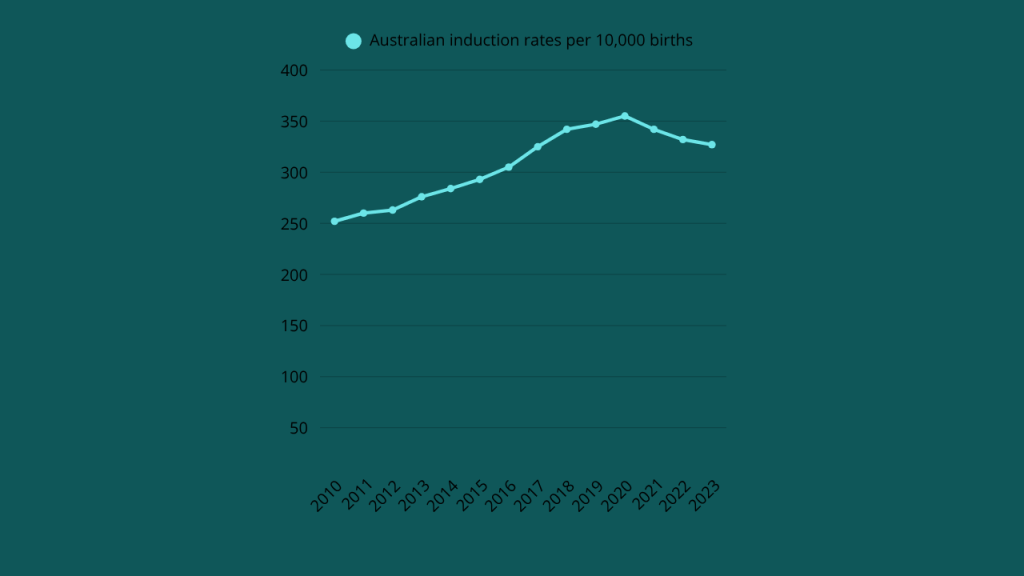
Labour began with an induction for 32.7% of women. The rate of induction had been steadily rising from the lowest rate in 25 years in 2008, when it was 24.8%. The rate peaked in 2020 at 35.7%, and has declined since then. The proportion of woman not labouring at all has progressively increased over time, from 19.1% in 2011 to 26.7% in 2023. Not surprisingly, the proportion of women with spontaneous labour onset has dropped in a fairly spectacular manner from 56.0% in 2010 to 40.3% in 2023.
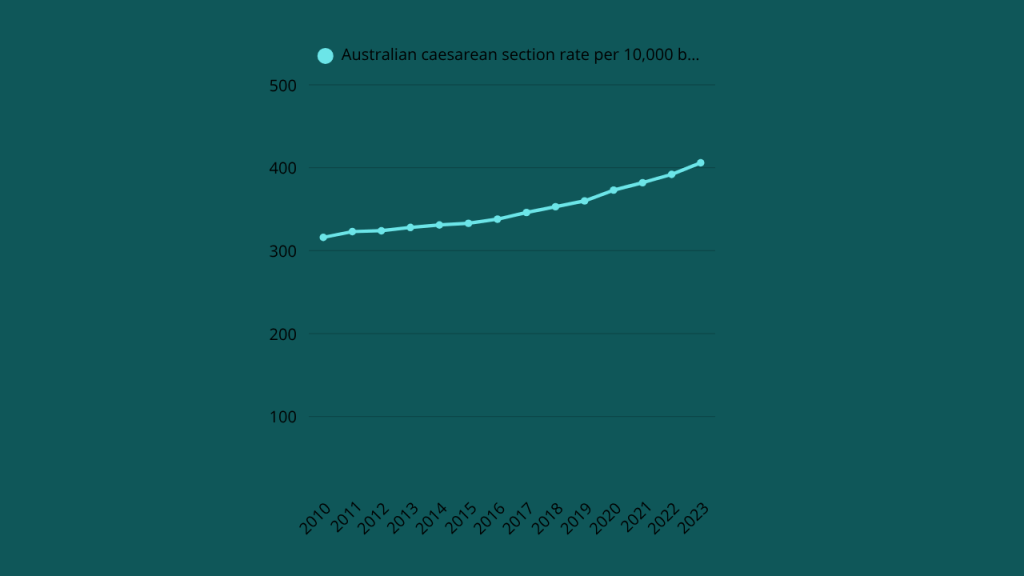
The caesarean section rate continues to rise. In 2007, 30.9% of women gave birth by caesarean section. In 2023, the rate passed 40% for the first time – reaching 40.6%. The use of forceps assistance has remained steady at 4.0% in 2010 and 4.3% in 2023. There’s been a small fall in the use of vacuum assistance, from 8.1% in 2010 to 6.6% in 2023.
Women giving birth
The birth rate per woman (aged 15 to 44 years) was 52 per 1,000 women. This rate has been falling since 2007, when it was 66 per 1,000 women. Over the same time period the average at of women at the time of birth has risen ever so slightly from 29.9 years to 31.3 years.
Fewer women reported smoking at any time during pregnancy – falling from 14.5% in 2009 to 7.8% in 2023. The proportion of women with a BMI in the “obese” category has increased from 16.3% in 2011 to 23.4% in 2023. There has been a marginal increase in the proportion of women with gestational diabetes over time, rising from 13.7% in 2018 to 16.8% in 2023. The proportion of women with preeclampsia or eclampsia has changed minimally, with a rate of 2.0% in 2018 and 2.7% in 2023.
Maternal mortality rates are not yet available for 2023, but have been published for 2022. There has been a fall in the past two decades, from 11.1 per 100,000 women in 2000-2002, to 5.3 per 100,000.
Outcomes for babies
While the incidence of birth before 36 weeks has remained steady (8.3% in 201 and 8.4% in 2023), there have been a noticeable movement towards earlier birth around term. Only 19% of babies are now born at or after 40 weeks of gestation, down from 26% in 2010. More babies are being born at 37, 38, and 39 weeks than was the case in 2010.
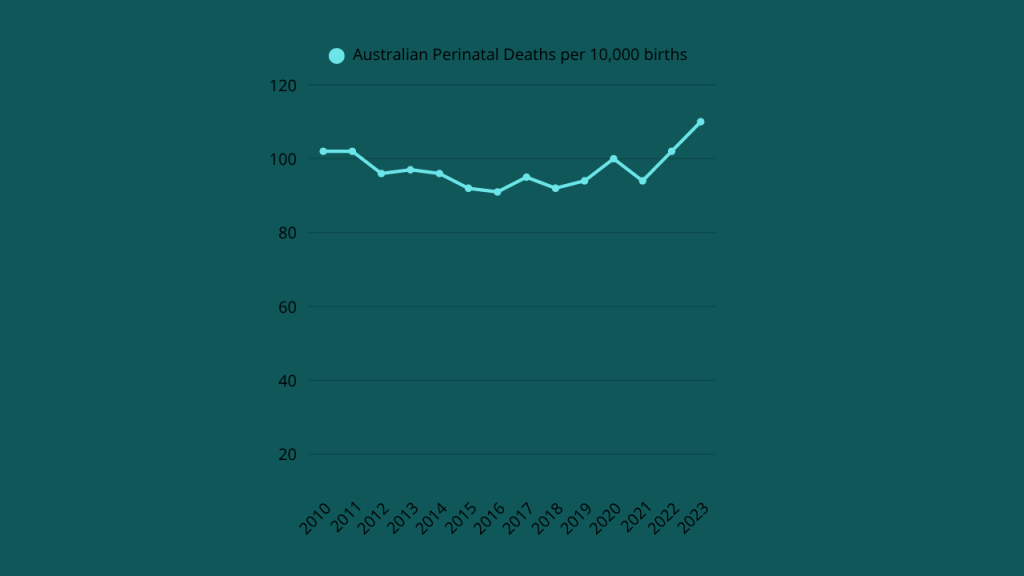
This stillbirth rate in 2023 was 8.7 per 1,000 births, and the neonatal mortality rate 2.3 per 1,000, giving an overall perinatal mortality rate of 11.0 deaths per 1,000. The perinatal mortality rate in 2010 was 10.2 per 1,000, falling to a low of 9.1 in 2016, with a gradual rise ever since. Neonatal death rates have fallen from 2.9 per 1,000 in 2010, so the rise in the overall death rate is due to rising stillbirth rates. Stillbirth rates were fairly static from 2010 to 2021, sitting between 6.7 and 7.7 per 1,oo0. In 2022 the rate rose to 7.9 and has continued its rise to 8.7 per 1,000 in 2023.
The AIHW commented that at least some of the rise in mortality rates might be due to higher rates of pregnancy termination after 20 weeks of gestation. They plan to do further analysis on these figures to measure the degree to which pregnancy termination contributes here. In 2022, 41% of perinatal death were attributable to pregnancy termination.
So is Australia on track to make birth safer?
It is disheartening to see the rise in perinatal mortality rate in this most recent data set. More fine grained analyses looking at gestational age and the role of pregnancy termination and congenital anomalies will come in another year or two. Much effort has been poured into attempts to reduce the stillbirth rate over the past decade – notably through the Safer Babies Bundle. The rates of induction of labour and pre labour caesarean section, and along with this the shift towards birth at 37-39 weeks and away from birth at 40 – 41 weeks, is clear evidence that interventions are being used in an attempt to shift the perinatal mortality rate.
Further analysis is required before we can reach conclusions about the effectiveness or otherwise of the increased rate of induction and caesarean section. It is reassuring to see that maternal mortality rates are not rising, in spite of the rise in birth intervention. So to answer the question I started with – are we on track to make birth safer? At present it isn’t looking like we are headed in the right direction…
I remain grateful that the Australian Government funds national data collection, analysis, and public reporting of outcomes. The amount of information available in the annual reports has consistently improved over time. Good decisions at policy level require good data.
Planning an VBAC? Been told you “need” to have CTG monitoring?
Maybe your last birth involved one or more of these?
- Being told you HAD to have CTG monitoring
- Having someone “pop a little clip on the baby’s head” without bothering to get your informed consent
- Found the CTG monitoring equipment uncomfortable and limiting for your freedom to move
- People wandering in and out of the birth room to look at the monitor without talking to you
- Everything suddenly turning to chaos because of some change on the monitor and feeling like you had no control over what happened next
It’s no wonder you are looking for a better birth experience this time, while not making compromises on safety. My course I’m having a VBAC. Do I need fetal monitoring? is your solution to feeling powerless and uncertain about what to do to prevent a repeat of your previous experiences. It’s a short course but big on evidence, with easy to understand summaries of what researchers have show about different types of fetal monitoring during VBAC. You’ll also find practical and effective communication strategies that help make sure you get the type of fetal monitoring you want for your birth.
Enrol now and start learning today!
Access the course instantly!
Reference
AIHW. (2025). Australia’s Mothers and Babies. 2023. https://www.aihw.gov.au/reports/mothers-babies/australias-mothers-babies/contents/about
Categories: Perinatal mortality, Stillbirth
Tags: AIHW, Australia, caesarean section, Induction of labour, instrumental birth
 Birth Small Talk
Kirsten,Depressing stats overall. But as you say
LikeLike
Yeah, disappointing that things are heading in the wrong direction. More analysis is definitely needed before planning what to do next though.
LikeLike