
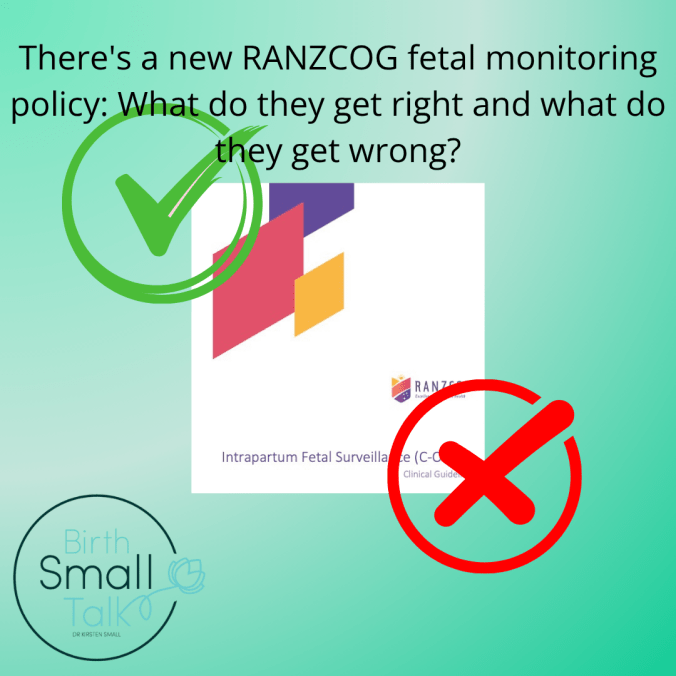
The Royal Australian and New Zealand College of Obstetricians and Gynaecologists (RANZCOG) published a new (the fifth) edition of their Intrapartum Surveillance guideline recently. One of the things I did in my doctoral thesis was to critically analyse the guideline (the 3rd edition was the current one at the time). As an obstetrician with decades of clinical practice, I have also engaged with all four of the previous versions in my practice. Safe to say, I am intimately familiar with the fine print of them all. I have written several blog post criticising claims made in previous versions (like this one and this one).
So – let us take a quick look at the new fifth edition. Have they fixed the problematic bits of the guideline, or made it worse?
What they got right
RANZCOG adopted a new approach to incorporating evidence into their guidelines in 2022, and this is the first revision under this approach. It is clearly visible and a very welcome change. Most notably, there’s a HUGE (for RANZCOG) difference in the “authority” attached to the recommendation that “it is suggested that continuous CTG should be offered in labour when risk factors for fetal compromise have been identified antenatally, at the onset of labour, or during labour” (new recommendation 5, was recommendation 7). The 2019 version of the guideline (and those prior to it) claimed there was Level 1 evidence to support this, citing the Alfirevic et al., 2017 Cochrane review (that says nothing like this). Instead, the strength of the evidence attached to this recommendation is now “low”, and the recommendation is labelled as “conditional” – a more accurate representation of the reality of the situation.
To match this, the language has also softened from “should be recommended…” to it being a suggestion that it “should be offered…”. It might not look like much but there is a difference between a suggestion (putting something on the menu of options) and a recommendation (pointing at this item on the menu and saying you should really have this one).
There are also improvements in the way the evidence supporting the list of risk factors for fetal compromise is presented, again making the strength (or weakness) of the evidence clearer. The previous version of the guideline included 41 factors on the list, most earning their place via consensus opinion (in other words – cos we think so…). Now there are 14 in a box labelled “moderate pertaining evidence”, 18 in a box labelled “low to very low certainty evidence”, and 7 in a box labelled “conflicting evidence or evidence of no association”, a total of 39.
I do hope that maternity professionals show these boxes to women when counselling and choose the wording of their conversations to match. For example – when speaking with a woman planning a VBAC, say “there’s only low quality evidence to suggest that you are at increased risk”; rather than “the guidelines say you should have CTG monitoring”.
What they (still) get wrong
At first glance there is a pleasing movement towards stronger support for women’s decision-making autonomy, but it remains fairly superficial. Scratch the surface a bit and we are back to obstetricians as the decision-makers. For example, in good practice statement 8 “the decision to use CTG in the setting of extreme preterm labour should be made in consultation with a senior obstetrician, taking into account … women’s preferences for obstetric intervention for an abnormal CTG”. Surely the decision should be made by the woman, with a senior obstetrician providing information and support for her decision making?
The reversion to obstetric control is also visible in the clinical questions used to frame up their literature reviews. For example question 2 (on page 31) asks “should women without indications for continuous CTG have either a CTG or auscultation at the time of admission?”. A better question would be to ask whether women who have a CTG on admission have different outcomes to those who have auscultation instead. Women can and will make the decision to have, or not, an admission CTG on the basis of that evidence.
Despite the guideline writers having a stated goal of foregrounding women’s autonomy, the clues that this has historically been ignored remain visible. Obstetric dominance is a baked on part of our history and the work of critically examining current practices and transforming them is not yet done in this new guideline version.
Overall…
I’m actually pleasantly surprised with the new edition. I am yet to have the time to dig about in the appendices to examine the quality of the work that sits behind the recommendations. This is on my list of plans for 2026, so stay tuned!
Planning an VBAC? Been told you “need” to have CTG monitoring?
Maybe your last birth involved one or more of these?
- Being told you HAD to have CTG monitoring
- Having someone “pop a little clip on the baby’s head” without bothering to get your informed consent
- Found the CTG monitoring equipment uncomfortable and limiting for your freedom to move
- People wandering in and out of the birth room to look at the monitor without talking to you
- Everything suddenly turning to chaos because of some change on the monitor and feeling like you had no control over what happened next
It’s no wonder you are looking for a better birth experience this time, while not making compromises on safety. My course I’m having a VBAC. Do I need fetal monitoring? is your solution to feeling powerless and uncertain about what to do to prevent a repeat of your previous experiences. It’s a short course but big on evidence, with easy to understand summaries of what researchers have show about different types of fetal monitoring during VBAC. You’ll also find practical and effective communication strategies that help make sure you get the type of fetal monitoring you want for your birth.
Enrol now and start learning today!
Access the course instantly!
References
Alfirevic, Z., Devane, D., Gyte, G. M. L., & Cuthbert, A. (2017, Feb 03). Continuous cardiotocography (CTG) as a form of electronic fetal monitoring (EFM) for fetal assessment during labour. Cochrane Database of Systematic Reviews, 2(CD006066), 1-137. https://doi.org/10.1002/14651858.CD006066.pub3
Royal Australian and New Zealand College of Obstetricians and Gynaecologists. (2025). Intrapartum Fetal Surveillance (C-Obs 1). Clinical Guideline. https://ranzcog.edu.au/wp-content/uploads/Intrapartum-Fetal-Surveillance.pdf
- Why artificial intelligence systems for fetal monitoring are so seductive to healthcare systems (and why that is a huge ethical problem)
- Thanks 2025 – and now on to 2026!
Categories: CTG, EFM, Obstetrics
Tags: guidelines, decision making, Autonomy, Evidence-based
 Birth Small Talk
Hey Kirsten, I would absolutely be keen to get to know the ins and outs of this guideline with you!
Kind regards,
Hannah Faul Director/Midwife
0402 915 508 hannah.faul@mymidwives.com.au http://www.mymidwives.com.au
My Midwives acknowledge the Aboriginal and Torres Strait Islander people as the Traditional Custodians across the lands on which we live and work, and we pay our respects to Elders both past and present.
This email, together with any attachments, is intended for the named recipient(s) only; and may contain privileged and confidential information. If received in error, you are asked to inform the sender as quickly as possible and delete this email and any copies of this from your computer system network. If you are not the intended recipient of this email, you must not copy, distribute or take any action(s) that relies on it; any form of disclosure, modification, distribution and /or publication of this email is also prohibited. Unless stated otherwise, this email represents only the views of the sender and not the views of the My Midwives. Please consider the environment before printing this email.
LikeLike
Fabulous! Make sure you pop your name on the list (link at the bottom of the post). I’ll be in touch early in the new year with details…
LikeLike