
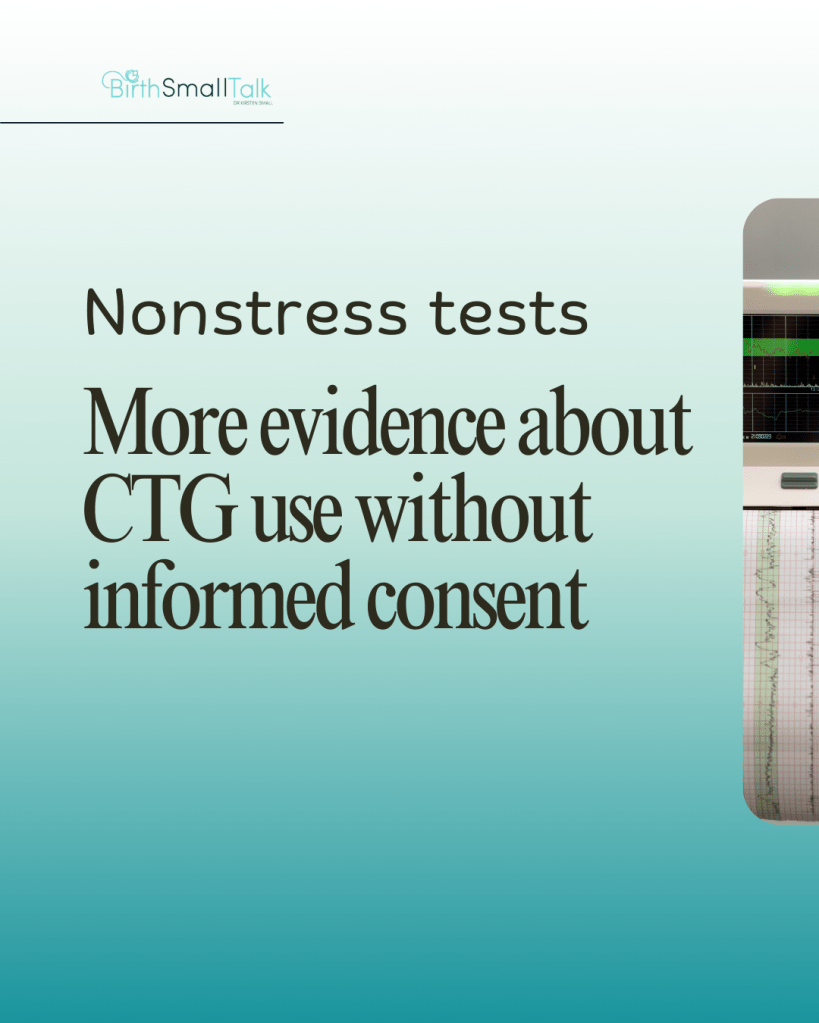
In some parts of the world, using CTG monitoring prior to the start of labour is called a non-stress test. I simply call it antenatal CTG monitoring. The amount of research that has been done about whether it improves outcomes is small (and the findings suggest it is may well be a harmful practice). There’s also not much research on women’s experiences with antenatal CTG use. There is some (now quite old) evidence that it increases women’s stress (ironic really, if you are calling it a non-stress test).
So I was delighted when I saw that a group of researchers based in Maryland, USA had published new research exploring women’s understandings of the reason for antenatal CTG monitoring and the impact it had on them (Kunzmann et al., 2025). Let’s see what they did, and what they found.
What did they do?
The research team recruited women who were attending a fetal assessment unit for antenatal CTG monitoring, having been referred due to a pregnancy complication or an underlying medical condition, right after their assessment was complete. Interviews were held with 17 women who agreed to take part in the research. Questions focussed on informed consent for the monitoring, and the emotional impact monitoring had.
What did they find?
They described that the “universal theme” of the interviews was about limited understanding of the testing, describing insufficient information sharing from maternity professionals. There seems to have been an assumption that women didn’t need to know about the testing, with one woman saying “They never mentioned anything about nonstress testing at all. They told me you’ll be going over there… no one’s mentioned anything about a nonstress test”.
The details of what the test involved were poorly understood by some, with women describing that “they check to see if the baby does 20 kicks within a certain time frame”, or “to monitor, you know, my blood pressure and the fetal movement”. The risks of monitoring appeared to also not have been discussed prior to or during testing. Women described antenatal CTG monitoring as having no “real risk to myself or the baby”, or “harmless”. Some reported looking for information from the internet and from other people to better understand what was involved in the testing.
When asked about whether they felt they had a choice about having the CTG monitoring, it was clear that informed consent was not given by some of the women. One woman described clearly the absence of this, saying “they didn’t explain it to me. They didn’t ask for my consent if I want to do it or not.” Others described feeling as though there was no other option: “So I don’t really feel like I had a choice because I am having twins.” Another reported the use of coercion, saying “it also sometimes feels like there’s an agenda that the doctors and nurses are trying to push”.
Reported benefits from CTG monitoring included a sense of reassurance that “she’s healthy in there and that she’s okay”. CTG monitoring was described as an “extra line of security to make sure that the baby’s still doing well”. The time cost of monitoring was an issue for some: “It’s difficult because I have two kids at home. I have a full-time job, and I drive my mum back and forth to work, and my husband has a job … it’s an increased burden”. Others spoke of the additional anxiety that comes from heightened surveillance, with that anxiety persisting over time: “I kind of feel like it increases stress just because I’m going to constantly be thinking about like, is he moving enough? How much is enough?”
What next?
It’s worth bearing in mind that the women who were interviewed had all just finished having a period of CTG monitoring. Women who were referred but who decided not to attend for monitoring may well have different things to say about informed consent for CTG use.
The authors, not surprisingly, recommend that women be provided with better resources to help with decision making. They acknowledged the challenge of this in a workforce that is already overstretched, and noted women’s willingness to look online for information. They said that women “often struggled to identify and access reliable, high yield resources”.
Wouldn’t it be good if someone wrote a blog and covered the evidence? Or maybe an entire book?
If you know someone who would benefit from more information, please let them know about my work. It saddens me to think that people who really need it may not be able to find it.
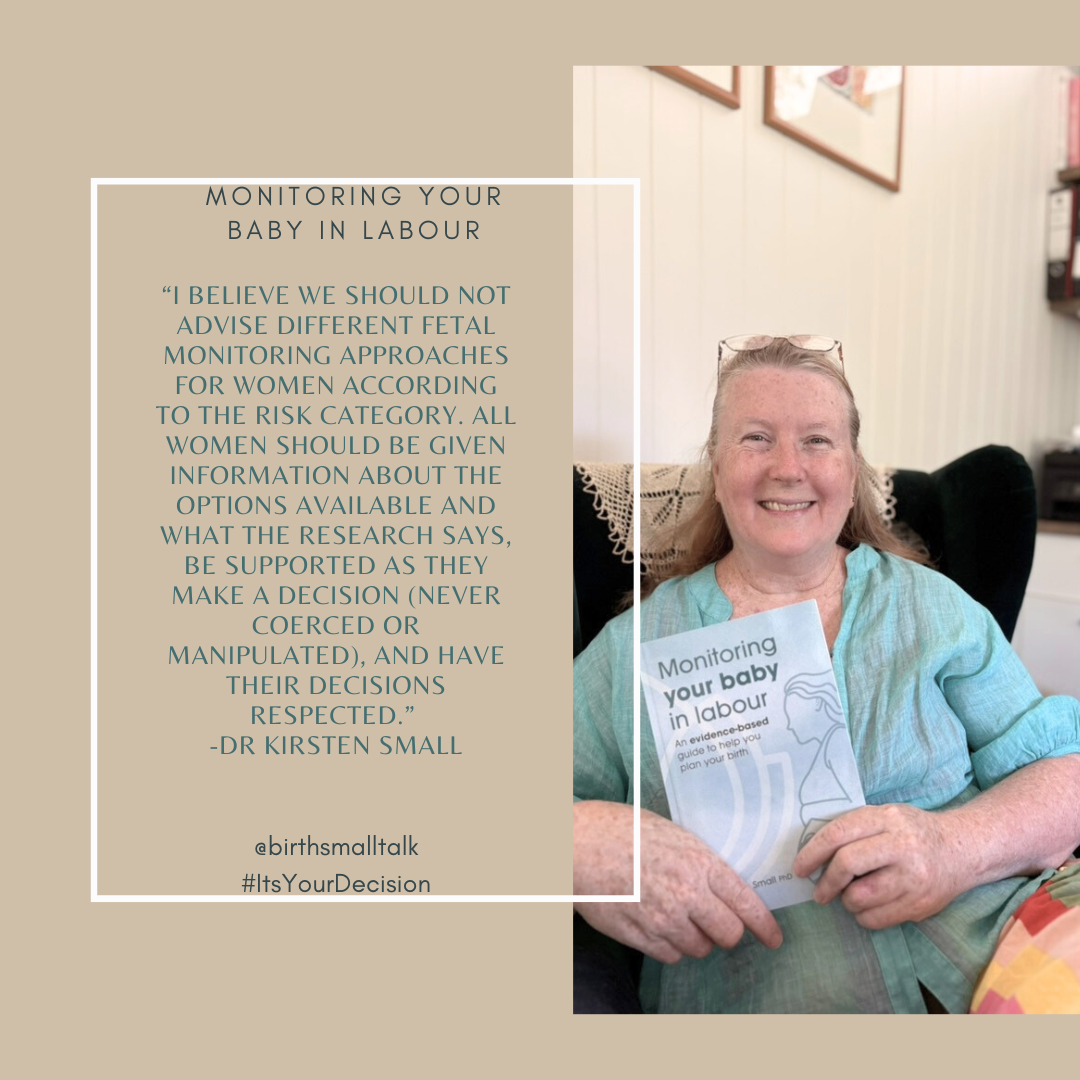
Decisions about fetal monitoring are for YOU to make. This is true whether you are considered “high risk” or not. It remains true even when someone tells you that you don’t have a choice and that CTG monitoring is mandatory. My recently published book Monitoring your baby in labour: An evidence-based guide to help you plan your birth supports you to make these decisions. Information about antenatal CTG testing is included.
Buy your copy today
References
Kunzmann, M. J., Witkop, C. T., & Thagard, A. S. (2025). Are nonstress tests stressful? A qualitative study of patient perceptions of antenatal surveillance. Birth, in press. https://doi.org/10.1111/birt.70044
Categories: CTG, EFM, New research
Tags: antenatal CTG, anxiety, Informed choice, Non-stress test
 Birth Small Talk