
Welcome back for part 3 of a three week series, where I step you through some common myths about fetal heart rate monitoring that pop up in peer reviewed literature. You can find the first post here and the second here.
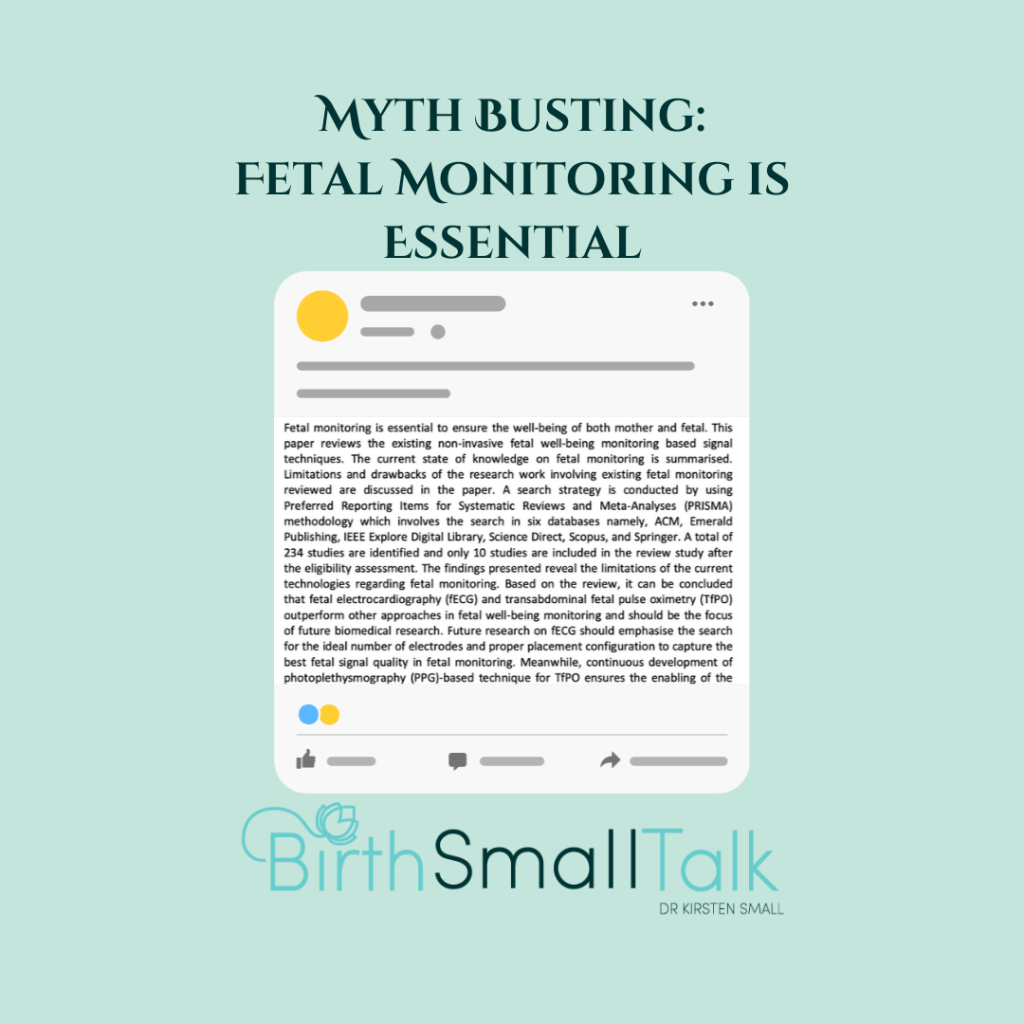
This is the segment of writing that caught my eye this time:
Fetal monitoring is essential to ensure the wellbeing of both mother and fetus. This paper reviews existing non-invasive fetal well-being monitoring techniques.
The author of this paper came from a country where English is not the primary language. Writing in research English is hard work and I have no intention of criticising that aspect of their writing.
Fetal monitoring is essential to ensure the well-being of both mother and fetus
I touched on the myth that fetal monitoring improves outcomes for women previously, so I won’t revisit that one again. (See how the same myths pop up over and over? This is why this series is about critiquing ideas, not the specific authors or their research.)
The word “essential” means absolutely necessary or extremely important. For example, an essential amino acid is one that must be consumed in the diet as the body can’t make it and ill health would occur without it. Would all or even most fetuses experience poor health if we suddenly stopped using modern technological approaches to fetal monitoring? Of course not!
Can fetal monitoring ensure (promise, guarantee) ongoing fetal wellbeing? Who knows! There has never been any research comparing using a technological approach to fetal monitoring (like intermittent auscultation or CTG monitoring) with not doing that approach. We simply do not know whether what we are doing makes a difference.
Coming in close as possible evidence is research designed to answer the question of whether surgical birth, rather than waiting, improves outcomes when there is suspected “fetal distress”. You would think there would be good research underpinning this belief, but no. There is a Cochrane review on this topic (Hofmeyr & Kulier, 2012). They found one study, done in 1953, and that therefore predates the introduction of CTG monitoring. Surgical birth (either caesarean, forceps, or vacuum assisted) did not reduce perinatal mortality compared to waiting when fetal distress was suspected.
Fetal heart rate monitoring (such as CTG or intermittent auscultation) isn’t essential to achieve good outcomes and its use does not ensure poor outcomes are avoided.
What would I write instead? “Fetal monitoring aims to reduce fetal and neonatal mortality and morbidity.”
Intermittent auscultation isn’t a noninvasive fetal monitoring option
What you can’t see from the snippet attached is that this was a literature review looking at non-invasive approaches to fetal monitoring. But the authors didn’t include intermittent auscultation in their review. This was of course, the first non-invasive approach to fetal monitoring used by maternity professionals.
Leaving it off the list of non-invasive options generates the impression that it isn’t worthy of occupying a spot on the list of approaches to fetal heart rate monitoring. Or that it isn’t a kind of fetal monitoring. Yet the research comparing intermittent auscultation with CTG use shows it is just as effective at preventing death and long-term brain injury (Alfirevic et al., 2017).
What would I write instead? There are two options here. The first would be to have included intermittent auscultation in the search terms and reviewed the evidence alongside all the other non-invasive approaches. The second would be to include clearer terminology about what exactly is going to make the cut. Referring to non-invasive options for continuous fetal monitoring in labour would be clearer.
Since I decided that I would leave this as a three part series, I have already spotted another abstract that contains more fetal monitoring myths. I plan to keep collecting these, and will do some more myth busting at a later date. If you find anything in the peer reviewed literature, send me a copy and I’ll add it to my collection!
Sign Up for the BirthSmallTalk Newsletter and Stay Informed!
Want to stay up-to-date with the latest research and course offers? Our monthly newsletter is here to keep you in the loop.
By subscribing to the newsletter, you’ll gain exclusive access to:
- Exciting Announcements: Be the first to know about upcoming courses. Stay ahead of the curve and grab your spot before anyone else!
- Exclusive Offers and Discounts: As a valued subscriber, you’ll receive special discounts and offers on courses. Don’t miss the chance to save money while investing in your knowledge development.
Join the growing community of BirthSmallTalk folks by signing up for the newsletter today!
Sign up to the Newsletter

References
Hofmeyr, G. J., & Kulier, R. (2012, Jun 13). Operative versus conservative management for ‘fetal distress’ in labour. Cochrane Database Syst Rev, 2012(6), CD001065. https://doi.org/10.1002/14651858.CD001065.pub2
Alfirevic, Z., Devane, D., Gyte, G. M. L., & Cuthbert, A. (2017, Feb 03). Continuous cardiotocography (CTG) as a form of electronic fetal monitoring (EFM) for fetal assessment during labour. Cochrane Database of Systematic Reviews, 2(CD006066), 1-137. https://doi.org/10.1002/14651858.CD006066.pub3
- Myth Busting #2: CTG misinterpretation harms babies
- Are “medical indications” a form of manipulation?
Categories: CTG, EFM, Language, Reflections
 Birth Small Talk