
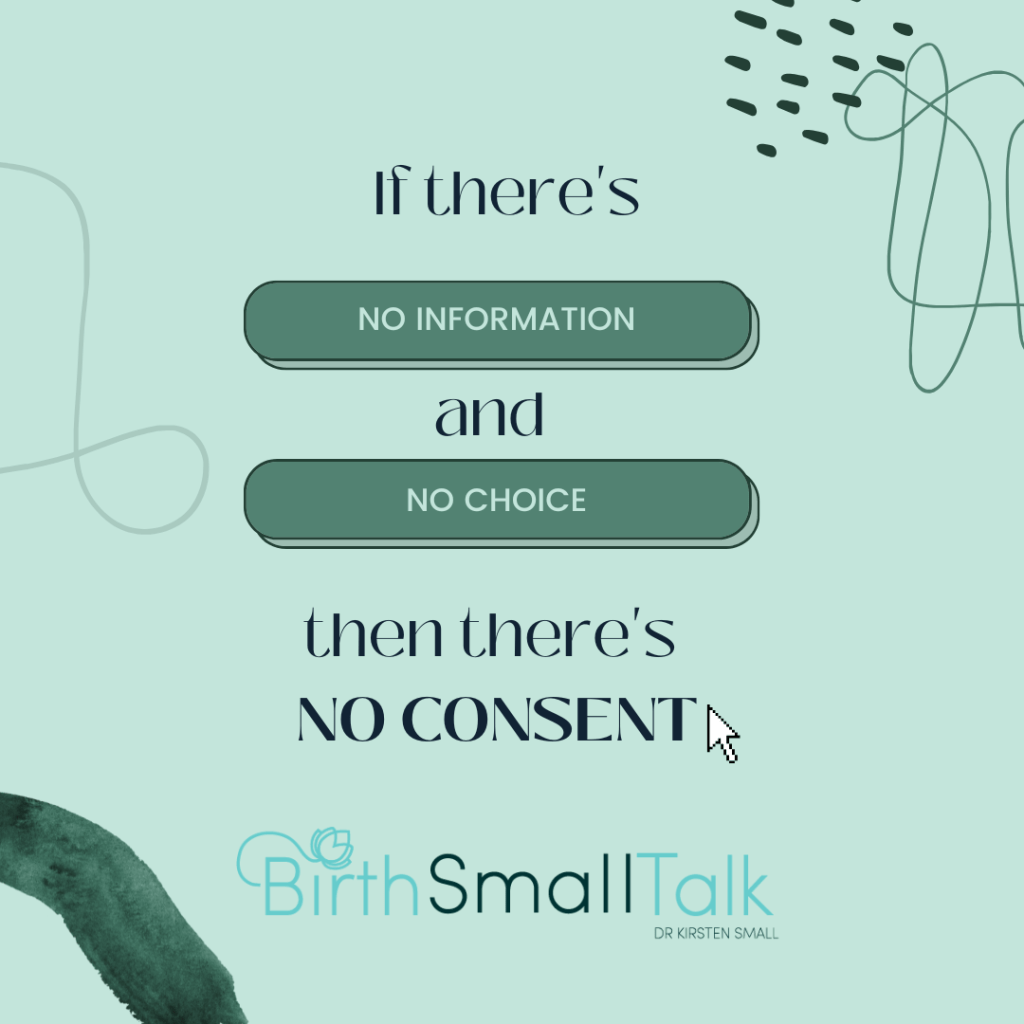
One of the fundamental ethical and legal principles of healthcare is the idea of informed consent. If a healthcare provider wants to do something to someone’s body, they must provide information about what it is they want to do, why, how it might benefit that person, and whether there might be some downsides to having the thing done. The person then gets to make a decision about whether they want that thing done, or not. If there is no information sharing, and no choice being offered, and the thing gets done – it is being done without consent. In maternity care circles, the unconsented use of interventions is considered one form of obstetric violence (Montanari Vergallo et al., 2024).
Fetal monitoring and consent in the spotlight once again
New Australian research has, again, demonstrated a significant problem with informed consent for fetal monitoring. Levett and colleagues (2024) surveyed Australian women in 2022, aiming to:
- Identify where women get information about fetal monitoring,
- Find out if women felt they had enough information and a choice about different types of fetal monitoring,
- Find out if there were barriers to them getting their preferred type of fetal monitoring,
- See if they would choose the same thing or something different for their next birth, and
- Learn more about women’s experiences of different kinds of fetal monitoring.
To do this, they built an online survey and circulated it widely on social media (I shared the link to it at the time), asking women who had given birth in Australia in the past five years to complete the survey. All up, 861 women provided information in the survey. Most were born in Australia, had given birth to their first baby, and had a university education. Most gave birth in hospital, with 6% giving birth in a birth centre. 65% had been to a childbirth and parenting education class.
The survey asked whether care providers had discussed fetal monitoring with them: 36% said no, 31% said yes but it was brief, and only 12% said they were given detailed information (others couldn’t remember or provided no answer for this question). When the care provider did explain – it was more likely that the care provider was a midwife than an obstetrician. Only 21% of women felt they had enough information about fetal monitoring.
Even more disturbing was the finding that only 35% reported having been asked to consent to the form of monitoring being used, and 26% were not asked for consent (the remainder couldn’t remember if they had been asked, or didn’t answer the question).
Did the type of monitoring that was used make a difference to information and choice?
There was a big difference in the proportion of women who said they had enough information about the type of monitoring, according to the monitoring that was used:
- 67% of women monitored with a handheld device like a Doppler
- 27% of women monitored with standard CTG monitoring (the kind with wires)
- 3% of women monitored with a fetal spiral electrode
- 41% of women monitored with wireless or telemetry CTG monitoring
A large minority of women using each of the different fetal monitoring approaches reported not knowing they could have had a different choice:
- 17% of women monitored with a handheld device like a Doppler
- 29% of women monitored with standard CTG monitoring (the kind with wires)
- 32% of women monitored with a fetal spiral electrode
- 23% of women monitored with wireless or telemetry CTG monitoring
Note that the women who had the least invasive approach to fetal monitoring (intermittent auscultation with a handheld device) were most likely to have had enough information and were least likely to know that this was a choice; while those who had the most invasive approach (a fetal spiral electrode) almost never were given enough information and one third were given the impression they had no choice about using it!
Comfort levels and future choices
The highest comfort levels were for monitoring with a handheld device, then wireless CTG monitoring, with wired CTGs being the least comfortable option (and the most commonly used). Three quarters of women who had handheld monitoring indicated they would choose it again, while 69% of women who had used wired CTG monitoring said they would not use it again.
What do we do about this?
It is tempting, and easy, to point the finger at individual maternity care providers and tell them they have to do better. While there it is clear there is room for improvement here, it is vitally important to take three steps back and ask some important questions. The unconsented use of fetal monitoring is so common that it could be considered the standard of care.
Yet, it seems clear to me that the path of least resistance for maternity professionals is more often than not to proceed without information sharing or consent seeking. To solve this problem, we need to understand why this isn’t considered a national healthcare crisis, and why maternity professionals are not being held to account regularly for failing to meet the standards of their profession. We need a significant revolution in maternity care, and my word IT IS TIME!
Sign Up for the BirthSmallTalk Newsletter and Stay Informed!
Want to stay up-to-date with the latest research and course offers? Our monthly newsletter is here to keep you in the loop.
By subscribing to the newsletter, you’ll gain exclusive access to:
- Exciting Announcements: Be the first to know about upcoming courses. Stay ahead of the curve and grab your spot before anyone else!
- Exclusive Offers and Discounts: As a valued subscriber, you’ll receive special discounts and offers on courses. Don’t miss the chance to save money while investing in your knowledge development.
Join the growing community of BirthSmallTalk folks by signing up for the newsletter today!
Sign up to the Newsletter

References
Levett, K. M., Fox, D., Bamhare, P., Sutcliffe, K. L., Coddington, R., Newnham, L., & Scarf, V. (2024, Oct 29). Do women have a choice when it comes to fetal monitoring? Perceptions of information provided and choice of fetal monitoring in Australia: A national survey. Women & Birth, 37(6), 101837. https://doi.org/10.1016/j.wombi.2024.101837
Montanari Vergallo, G., De Paola, L., Napoletano, G., Circosta, F., Gullo, G., & Marinelli, S. (2024). Obstetric violence: if you can recognize it, you can prevent it. Archives of Gynecology & Obstetrics, 310, 2745–2747. https://doi.org/10.1007/s00404-024-07722-9
Categories: CTG, EFM, IA, New research
Tags: Australia, Consent, decision making, Fetal spiral electrode, FSE, Informed choice, telemetry
 Birth Small Talk
So important! I’m a midwife. I was moved from the admissions ward because I explained the risks and benefits of the admissions trace that was part of hospital policy. Needless to say, when given the full picture, most women did not consent. The powers that be did not like this and I got a talking to. When I explained that it was my duty as a midwife and within my scope of practice and in alignment with the code of practice to ensure I had informed consent, they couldn’t really do anything, so I was moved to a different ward. I insist on getting proper consent for everything, even observations. We need a whole mind shift about this. The language needs to change. I cringe inwardly every time I hear a woman use the term “I was allowed” when referring to their birth experience.
LikeLike
Accurate information sharing and supporting decision making should get you promoted. It’s all upside down…
LikeLike
I would love to hear feedback from women in relation to the conversations that come following their declining of ctg monitoring. In my experience I have seen that midwives who are uncomfortable with a woman declining monitoring, will invite a HMO/Reg etc in for further ‘education’. If the woman continues to decline, the Dr then begins the bargaining phase of the power struggle.. what if we monitor for half an hour every two hours?
Which often becomes continuous monitoring because of (?)abnormalities .. or a care provider simply not removing it.
As wonderful as telemetric monitoring is for giving women increased freedom of movement and access to showers, I feel like it is often used as another carrot in the basket of the medical team to coerce reluctant women to agree to continuous monitoring. It’s so vital for pre birth education to include honest discussion about the fact that continuous monitoring is continuous monitoring.. regardless of the way the information is gathered (wired, telemetry, fse).
LikeLike
I have’t seen any research that explores women’s experiences of declining CTG use but it would be really interesting to ask the question. I’ve certainly seen what you describe – the escalating intensity of pressure to comply with the recommendation, sometimes coupled by the removal of other things the woman wants (like access to the bath). And I completely agree – CTGs are still CTGs no matter which sensors are being used.
LikeLike