
The Dawes Redman system uses computer software to check if set criteria (determined by obstetric researchers) are present or not in a CTG recording generated during pregnancy. Invented in Oxford, it is primarily used in the UK – I have never encountered it here in Australia. CTG monitoring in pregnancy is typically advised when there is a problem (like bleeding) or when the woman’s fetus is considered to be a higher risk for a poor outcome (like having diabetes, or being post-term). I have previously summarised the evidence from a Cochrane review about whether using the Dawes Redman system led to better outcomes compared to human interpretation of the CTG (it didn’t make a difference for babies without congenital anomalies – you can read that here).
Initial testing of the Dawes Redman system in the 1990s, showed a link between the CTG recording not meeting the criteria and higher levels of acid in umbilical cord blood at birth, but the research only included fetuses who were considered small for gestational age. The ability of the criteria to pick other important outcomes, and in other populations of interest, was not further investigated at the time the system entered clinical practice. The Dawes Redman system is currently recommended in the UK as part of the Saving Babies Lives bundle (NHS, 2019).
New research
An Oxford based team recently published new research, aiming to test the ability of the Dawes Redman system to rule out or predict a broad range of adverse pregnancy outcomes (Davis Jones et al., 2025). On their list of poor outcomes were: high cord blood acid levels, stillbirth or neonatal death, hypoxic ischaemic encephalopathy, admission to the neonatal special care unit for more than a week, Apgar scores of under four at one minute or under seven at five minutes, and the use of neonatal resuscitation at birth.
To answer their research question, they collected digital records of antenatal CTGs analysed with the Dawes Redman criteria that had been recorded between 1991 and 2024 in the Oxford University hospitals database. To be included, the women had to have been 37 – 41+6 days pregnant at the time the recording was generated, have clinical information available, and to have one or more of the adverse pregnancy outcomes they were studying. A comparison group consisted of women who also had a CTG recording on file, but who gave birth to one live baby between 37 and 41+6 weeks, who was not small for gestational age (more than the 10th %ile), had a labour duration of under 24 hours, normal Apgar and a normal cord pH result. A statistical method known as propensity score matching was used to choose a subset of women from the comparison group, to ensure the same proportions of women in both groups for gestational age at the time of monitoring, fetal sex, the woman’s body mass index, parity, age, and the time between the CTG and when they gave birth.
What did they find?
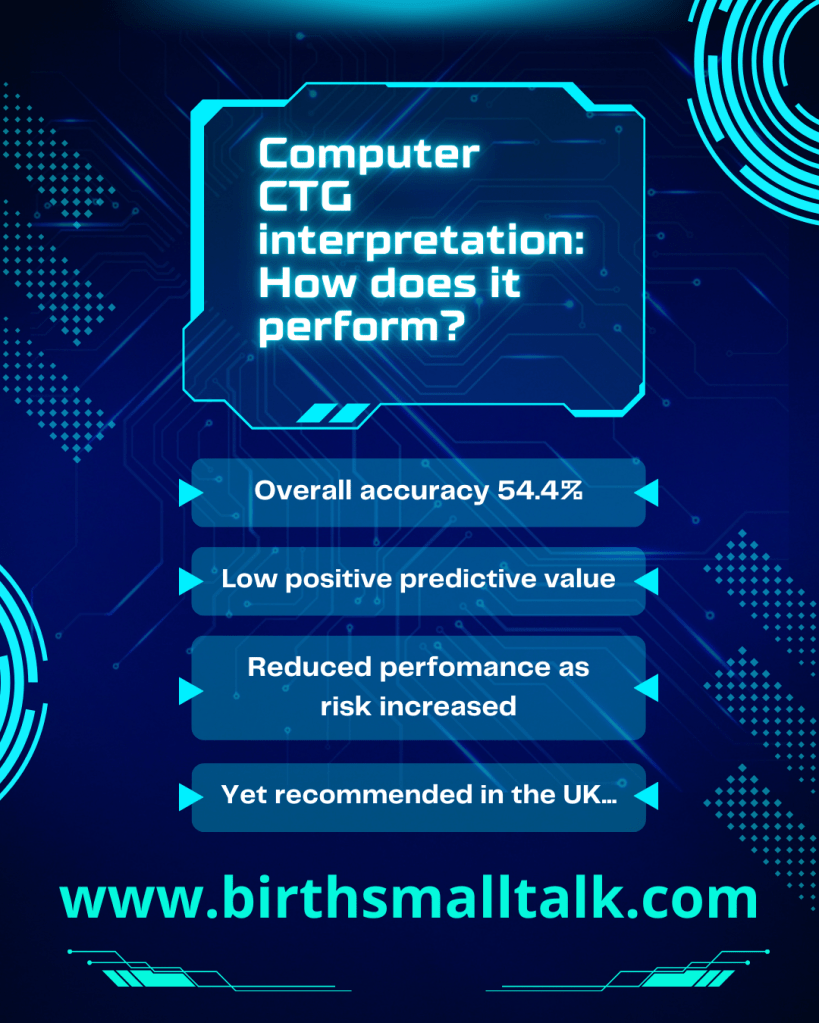
The researchers identified 1,658 women with an adverse pregnancy outcome and matched these to 1,658 women with no adverse pregnancy outcome. When the baby had a good outcome, 90.7% of babies had a CTG recording that met the Dawes Redman criteria (specificity). When the baby had one or more of the adverse pregnancy outcomes, 18.2% of babies had a CTG recording did not meet the criteria (sensitivity). Overall accuracy was 54.4% – little better than a coin toss.
For clinical purposes, it is better to look at these numbers the other way around. When the Dawes-Redman criteria were met, what proportion of babies had a good outcome (negative predictive value)? Because predictive values are affected by how often an outcome happens, the researchers performed a risk calculation to look at how good the predictive value was when the risk was considered to be very low (negative predictive value of 99.1%), low (90.9%), medium (81.6%), or high (72.1%). This means that for women at high risk who had a CTG trace that was considered normal by the Dawes Redman criteria, 27.9% of their babies had an adverse pregnancy outcome. It’s nowhere near as reassuring as you might expect it to be.
And when the Dawes-Redman criteria were not met, what proportion of babies had one or more of the adverse outcomes (positive predictive value)? The positive predictive value increased as the risk increased, being only 1.9% in the very low group, 17.6% in the low risk group, 32.7% in the medium risk group, and 45.4% in the high risk group. The system doesn’t perform well here either.
Did timing matter?
Next, the researchers looked to see if there was any relationship between how much time had passed between when the CTG was recorded and the birth, and the ability of the criteria to predict the outcome. As you would probably expect, the closer the CTG was to the birth, the better the accuracy (being 56.9% in the first 24 hours vs 51.8% between 24 – 48 hours). Negative predictive value didn’t change much between the two time periods, but the positive predictive value was better closer to birth (11.7% vs 6.7%).
Were the criteria better at predicting some outcomes than others?
Positive predictive value was highest for hypoxic ischaemic encephalopathy, but still fairly low at 18.6%, and lowest for predicting admission to the nursery (only 8.2%). Positive predictive values for death (stillbirth and death in the first week of life) was 12.3%. The negative predictive value was consistently between 95.4% and 96% for all outcomes.
So what does this mean?
This research is the first to fill a large gap in our knowledge about the Dawes-Redman system. It goes beyond the limited previous research in small for gestational age fetuses that looked only at cord blood acidosis, with a broader range of inclusion criteria and outcome measures being examined. It is important to note that this research tells us nothing about the use of the Dawes Redman system for women before 37 weeks, over 42 weeks pregnant, or with twins. All of these are situations where antenatal CTG monitoring is likely to be recommended. Further evidence would be very useful here!
It is also important to note that these CTG recordings were generated in clinical practice, where the information from the recordings was factored into decisions about care prior to and during labour. It is therefore impossible to know whether it was the decisions made on the basis of the CTG recording (like induction of labour or pre labour caesarean section) that led to the adverse pregnancy outcome, or whether the adverse outcome was due to some pre-existing fetal health issue. Nor does this type of research show that using the Dawes Redman system will lead to better outcomes than not using it. Other types of research are needed to answer these questions.
In the paper’s conclusion, the authors point out that the original purpose of the Dawes Redman system was to identify women who are at low risk of adverse pregnancy outcome. The negative predictive value of the test is therefore the most important feature. As women’s chance of a poor outcome increased, the negative predictive value fell. The test is therefore less useful in precisely the population who would most benefit from a high negative predictive value. This shortcoming, and the low positive predictive value, should be discussed with women as part of the consent process for antenatal CTG monitoring the using the criteria. Clinicians and women are currently putting more faith in this technology than it seems to deserve.
Once again, we see an example of a fetal monitoring technology being used without clear proof of benefit. There has been very little research about the use of the Dawes Redman system, and what we have highlights the shortcomings of the system. The endorsement of this system in the Saving Babies Lives bundle highlights that the bundle isn’t as evidence-based as people assume it to be.
Sign Up for the BirthSmallTalk Newsletter and Stay Informed!
Want to stay up-to-date with the latest research and course offers? Our monthly newsletter is here to keep you in the loop.
By subscribing to the newsletter, you’ll gain exclusive access to:
- Exciting Announcements: Be the first to know about upcoming courses. Stay ahead of the curve and grab your spot before anyone else!
- Exclusive Offers and Discounts: As a valued subscriber, you’ll receive special discounts and offers on courses. Don’t miss the chance to save money while investing in your knowledge development.
Join the growing community of BirthSmallTalk folks by signing up for the newsletter today!
Sign up to the Newsletter

References
Davis Jones, G., Albert, B., Cooke, W., & Vatish, M. (2025, Feb). Performance evaluation of computerized antepartum fetal heart rate monitoring: Dawes-Redman algorithm at term. Ultrasound in Obstetrics & Gynecology, 65(2), 191-197. https://doi.org/10.1002/uog.29167
NAtional Health Scheme. (2019). Saving Babies Livers. Version 2. A Care bundle for reducing perinatal mortality. https://www.england.nhs.uk/wp-content/uploads/2019/03/Saving-Babies-Lives-Care-Bundle-Version-Two-Updated-Final-Version.pdf
Categories: CTG, EFM, New research, Stillbirth
Tags: acidosis, antenatal CTG, Artificial intelligence, computerised interpretation, Dawes Redman, Oxford, Saving Babies Lives bundle
4 replies ›
Trackbacks
- Human rights and artificial intelligence in healthcare – Birth Small Talk
- Twenty fetal monitoring myths that won’t go away – Birth Small Talk
 Birth Small Talk
Dear Kirsten,
Turning a technology that keeps going around in circles without having anything to do with the final outcome isn’t science. Would you diagnose the result of typhoid fever simply by taking the pulse as they did 300 years ago? Obviously not. Fetal FHR monitoring is perfect, this is the same way of thinking, but the consequences, as still nowadays applied are disastrous, especially for the mother. I wonder what the reasons are behind continuing to allow this mess? I understand your efforts to continue giving meaning to these studies, but it’s time for the new generations of obstetricians and midwives to realize that this isn’t the way to go.
Thank you very much,
Joan M Adelantado
LikeLike
I agree – it’s time to end this nonsense and look for effective ways to prevent harm to women and babies.
LikeLike