
Today, I want to focus on the problem of incorrect information being shared by someone who should have been a trustworthy source but was not.
I’m not going to name names, as bringing down a wave of internet based criticism on the person responsible is not my vibe. What I’m about to describe is also not unique to this particular person. The goal of this post is to make sure that correct information is discoverable on the interwebs so that this particular piece of misinformation isn’t left to float around as though it was factual.
What was the misinformation?
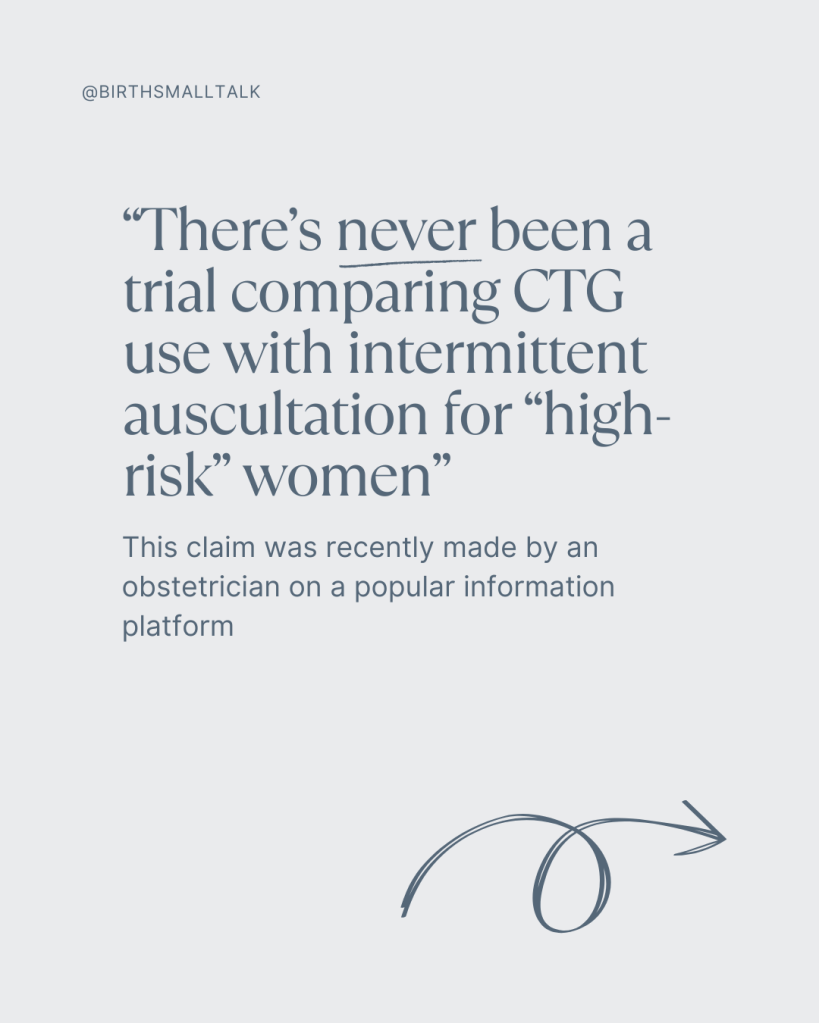
An obstetrician on a popular information platform recently made the statement that there has never been a trial comparing CTG use with intermittent auscultation for “high-risk” women. There’s a closely related myth that the majority of the research was done in low-risk populations. Potentially, these myths can leave women who have been told they are high risk feeling that there is little to no research out there that might be useful to inform their decisions.
Randomised controlled trials in high-risk populations
The first paper I published from my PhD research was a systematic review of research about CTG monitoring that included women considered to be at high risk (Small et al., 2020). The evidence we found also overlaps with the Cochrane review (Alfirevic et al., 2017). My paper looked at perinatal mortality and brain injury only – the Cochrane review includes other outcomes.
There are 11 randomised controlled trials about fetal monitoring in labour collected up in the Cochrane review. Five of these included ONLY women considered to be high risk, randomised to either CTG monitoring or intermittent auscultation. In summary they found:
- No difference in perinatal mortality
- No difference in seizures
- A statistically significant (and large) increase in cerebral palsy with CTG use
- A higher rate of caesarean section with CTG use
- No difference in the use of instrumental birth
Randomised controlled trials in mixed-risk populations
That doesn’t mean that the remaining six studies were done in low-risk populations. Four were from populations with a mixture of low- and high-risk women, or where the original authors don’t tell us what the risk status of the population was. Together the findings from this group of studies was:
- No difference in perinatal mortality
- No difference in seizures
- No difference in cerebral palsy
- No difference in the rate of caesarean section
- A higher rate of instrumental birth with CTG use
Were the low-risk trials really done in low-risk populations?
That leaves only two trials that have a low-risk label attached to them. But when you read these, all is not as it first seems. The first of these was done in Sheffield in the UK (Kelso et al., 1978). While they did exclude women with many things from a list of risk factors, half the women in this trial (252 of 504) were either induced or had their labour augmented with oxytocin. Women who had epidurals were also included. So this one is really a mixed-risk trial.
The remaining trial was done in Melbourne, Australia (Wood et al., 1981). On the face of it, this looks like it was done in a low-risk population. But the use of oxytocin doesn’t appear on their list of exclusion criteria. In Table 3, there’s an entry for “other drugs” used during labour. These drugs were not opiates as these are listed on a separate line of the table. From the total sample of 828 women in the study, 591 had at least one “other drug” administered – a very high rate for women who are meant to be low-risk.
I wondered whether the “other drugs” could include oxytocin. I reached out to one of the authors (Jeremy Oats) back in 2018 and asked if he could shed some light on what “other drugs” might have referred to and whether women might have been exposed to oxytocin. He was unable to recall and given the passage of time, he believed that none of the original data would remain to answer the question. So this study too, might possibly have been done in a mixed-risk population.
In summary…
It is possible that ALL the trials comparing CTG use with intermittent auscultation were done in populations that included women with risk factors. It is very easy to fact-check the suggestion that there have been none, or that most were done in low-risk populations. Yet the myths persist…
Were the trials in high- and mixed-risk populations fabulous research that clearly applies to the way we practice today? Absolutely not. They are old, some were prone to bias, there have been many changes in care provision, and things that now make it onto the list as being a risk factor (like abnormal umbilical artery Dopplers or a low PaPP-A) were not on lists in the past.
But the studies do exist. They are the best evidence we have. Ask yourself why people keep saying they don’t exist and see what comes to mind…
Maternity professionals have an obligation to have honest conversations with women about fetal monitoring options. It’s an important step in informed consent. But guidance on what to say and how to say it is not something that really ever gets discussed in fetal monitoring education sessions.
Are an experienced midwife who wants to have better conversations about fetal monitoring? I’m about to release a simple, repeatable, and personalisable framework for every fetal monitoring conversation. Register to find out more about it…
Ready to have better conversations?

References
Alfirevic, Z., Devane, D., Gyte, G. M., & Cuthbert, A. (2017). Continuous cardiotocography (CTG) as a form of electronic fetal monitoring (EFM) for fetal assessment during labour. Cochrane Database of Systematic Reviews, 2(2), CD006066. https://doi.org/10.1002/14651858.CD006066.pub3
Kelso, I., Parsons, R., Lawrence, G., Arora, S., Edmonds, D., & Cooke, I. (1978). An assessment of continuous fetal heart rate monitoring in labor: A randomised trial. American Journal of Obstetrics and Gynaecology, 131, 526-531.
Small, K. A., Sidebotham, M., Fenwick, J., & Gamble, J. (2020). Intrapartum cardiotocograph monitoring and perinatal outcomes for women at risk: Literature review. Women & Birth, 33(5), 411-418. https://doi.org/10.1016/j.wombi.2019.10.002
Wood, C., Renou, P., Oats, J., Farrell, E., Beischer, N., & Anderson, I. (1981). A controlled trial of fetal heart rate monitoring in a low risk obstetric population. American Journal of Obstetrics and Gynaecology, 141(5), 527-534. https://doi.org/10.1016/s0002-9378(15)33273-7
- Exploring the link between fetal heart rate patterns and brain injury
- What’s wrong with central fetal monitoring?
Categories: Basics, CTG, EFM, History, IA, Obstetrics, Perinatal brain injury, Perinatal mortality
Tags: Cochrane, high-risk, Low-risk, Misinformation, mixed-risk, Myths, RCT

