
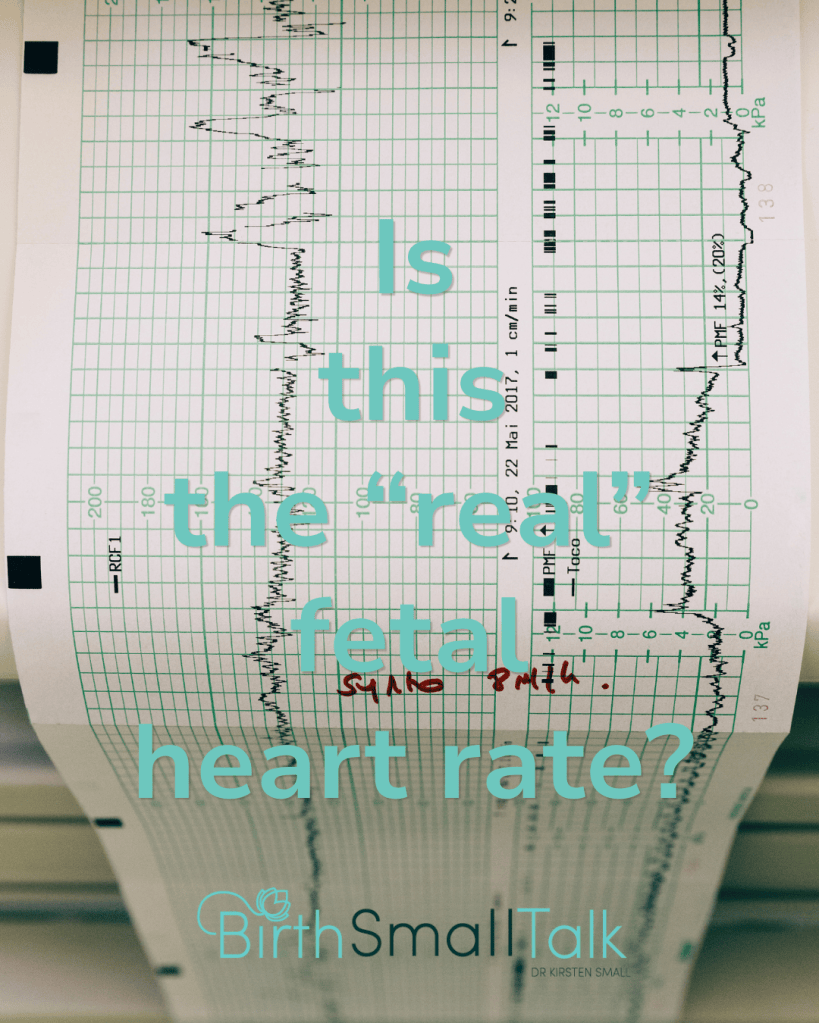
Earlier this year someone said to me that the reason for using different terminology to describe the same heart rate patterns when using the CTG (decelerations) or intermittent auscultation (decreases), was to highlight that only the CTG captured the “real” heart rate (or words to that effect). I argue that the fetal heart rate is the fetal heart rate, no matter which approach you use to measure it, and the physiology doesn’t change when the device does. Therefore the terminology shouldn’t change. This is particularly true when the comparison is between the heart rate as determined by the numbers on the screen of a handheld Doppler and the numbers generated with the Doppler sensor on the CTG CTG. The technology that goes into producing both is so similar that they can for clinical purposes be considered identical.
But that’s not the “real” heart rate
Neither is measuring the “real” heart rate however.
For those of you interested in this sort of thing – philosophically, I would probably describe my epistemological position about the fetal heart rate as we know it as social realism. I believe there is a “real” fetal heart rate, but that the only way we come to know it in clinical and research use involves technology (even the Pinard is technology) and interpretive frameworks that are all built in the social world. Anything social is subject to change and isn’t “real” in the same sense as the physical existence of a heart that is beating.
Last year I spotted a paper that illustrates the gap between what the fetal heart rate is actually doing, and what becomes the considered-as-true version of the fetal heart rate (Karmakar et al, 2025). Let me take you through that paper and explain why we should be a bit cautious about making claims that current commercially available CTG monitoring systems are telling us the truth about what the heart rate is doing.
What did the researchers do?
This work was done by a team of folks including clinicians and engineers, based in Melbourne Australia. In the introduction of the paper, the authors remind us that computer algorithms take the somewhat messy raw data obtained from a Doppler or ECG sensor and modify it. Missing values are guessed and added in. What seems like “noise” (a heart rate that doesn’t seem to fit) is smoothed over so it fits our expectations of what a fetal heart rate should be. This makes for a CTG trace that looks like what we expect a CTG trace to look like. Different manufacturers use different proprietary algorithms to get the job done – explaining why some are better at differentiating between maternal and fetal heart rates than others.
Up to 35% of the total recording time of a CTG can be data that has been generated by the algorithm rather than coming from the fetus. When computer interpretation models are trained or CTG datasets, they typically train them on the cleaned up data, not the raw data. This research team took a digital CTG data set from the Mercy Hospital of over 400,000 CTG episodes, including 36,000 generated during labour, where clinical outcomes were known, and looked to see whether there was a link between “messy” CTGs where the algorithm had substituted a lot of the signal and outcomes for babies. They defined perinatal asphyxia as one or more of perinatal death, hypoxic ischaemic encephalopathy, neonatal resuscitation followed by admission, Apgar of less than 7 at 10 minutes or less than 5 at 5 minutes, arterial pH < 7.05, and seizures.
What did they find?
They identified 32,242 CTG traces from women in labour at 36 weeks gestation or more with one baby that were suitable for analysis. “Asphyxia” was present for 860 babies (2.7%). They split the traces up according to those with more than 30% dropouts or more than 1% where maternal and fetal heart rates were the same, and those where this did not occur. Almost 20% of the CTG traces ended up in the high dropout group.
Women with high dropout rates were more likely to be giving birth for the first time, be considered low risk, in spontaneous labour, and to have a shorter labour. Having a CTG with a high dropout rate (meaning that much of what the care team was seen was the cleaned up data and not the “real” and messy data) was associated with a 40% increase in perinatal asphyxia (after careful mathematical adjustment to control for other possible causes for this link).
They then double checked their findings using a publicly available CTG database (the Czech CTU-UHB database) to see if their results held for a different population. They did – with slightly more than double the rate of asphyxia in the group with the high dropout rates. They also looked to see if there was a dose response – in other words when the CTG got messier and messier, did the risk get high or not? It did in both datasets.
What does this mean?
In the discussion of their paper, the authors focussed their recommendations on redesigning CTG technology to provide alerts when there is a lot of missing signal information. They also caution that more research is needed before changing what happens in clinical practice.
I want to draw your attention to the fact that more often than you might realise it, the bit of the CTG you are looking at is made up information generated by the computer in the CTG machine. I would not call that a “real” fetal heart rate, yet for all intents and purposes it is treated as such by clinicians and by legal teams. I started my book by saying that my goal in writing it was to show that “CTGs are nonsense”. This paper illustrates another way in which something that is believed to be solid ground turns out not to be.
So what do we do? I continue to call for honest conversations inside the professions and between maternity professionals and the general public about the limitations of our knowledge about fetal heart rate monitoring. We provide a grave disservice when we offer up simplistic but impossible to achieve promises, saying that close fetal monitoring with a CTG machine offers the best chance of avoiding a harmful outcome for the baby. The truth is, like many CTG tracings themselves, messy.
Decisions about fetal monitoring are for YOU to make. This is true whether you are considered “high risk” or not. It remains true even when someone tells you that you don’t have a choice and that CTG monitoring is mandatory. My recently published book Monitoring your baby in labour: An evidence-based guide to help you plan your birth supports you to make these decisions.
Buy your copy today

References
Karmakar, D., Mendis, L., Keenan, E., Palaniswami, M., Hastie, R., Makalic, E., & Brownfoot, F. (2025). Impact of missing electronic fetal monitoring signals on perinatal asphyxia: a multicohort analysis. NPJ Digital Medicine, 8(1), 233. https://doi.org/10.1038/s41746-025-01665-4
- Is the use of CTG monitoring by women at low risk a problem or not?
- Does wireless CTG monitoring help?
Categories: CTG, New research
Tags: Algorithm, asphyxia, Loss of contact, Melbourne, Messy data

