
BirthSmallTalk is two and a half years old, with over 150 posts. The last few months have seen a bunch of new people join me. (Hello! And thank you for dropping by!) I’ve decided it is time to go back to some of the earlier posts to refresh and update them, and given the entire blog a fresh look. This is the final week of a six week plan to revisit posts that cover some basic concepts and background information to help understand what is going on with fetal heart rate monitoring.
This is the third, and final, post in a series about the potential harms of CTG use. You can find the first post here and the second one here. This post looks at the possibility that CTG use might cause harm to the baby, while the two previous posts have examined harms for birthing women.
Cultural attitudes in high-income countries view infants as precious, pure, and vulnerable (Lupton, 2013a), and good motherhood is regarded as making personal sacrifices in order to protect their children (Lupton, 2013b). If women believe that CTG monitoring is of benefit for the baby, many are likely to make a decision favouring CTG monitoring in spite of their personal risk. On the other hand, if the baby might also be put at risk of harm, women would be unlikely to make the same choice. It is therefore important to examine what the evidence says about the possibility of harm to the baby from CTG use.
I’m going to summarise the evidence in three different categories. First, I’ll look at evidence from randomised controlled trials about worse outcomes for the baby when CTGs are used. Next, I’ll look at the small body of evidence relating to direct risks to the fetus from the use of internal fetal monitoring technology. Finally, I’ll examine evidence showing babies born by surgical birth are at higher risk for poorer health outcomes.
RCT Evidence: Are babies worse off when CTG monitoring is used rather than intermittent auscultation?
I have previously discussed evidence produced by Haverkamp and colleagues in 1976 that raised the possibility that the use of intrapartum CTG monitoring might increase the incidence of fetal heart rate abnormalities. Turning to the Cochrane review where the findings of all the randomised controlled trials comparing CTG monitoring with IA during labour are found (Alfirevic et al., 2017) we can see the following:
- The rate of cerebral palsy more than doubled (risk ratio of 2.54) when CTG monitoring rather than IA was used for high risk women (specifically those in premature labour). This reached statistical significance.
- The risk of neurodevelopment delay at 1 year of age was almost four times higher when CTG monitoring was used (but didn’t achieve statistical significance).
- There was no improvement in perinatal mortality (the chance of stillbirth during labour or the death of the baby in the first week of life) in either the low- or high-risk groups of women.
When we look at antenatal CTG use in women considered to be at risk (Grivell et al., 2015) we find a doubling of perinatal mortality (which just fails to reach statistical significance). Collectively, these findings put the idea CTG monitoring is harmless to the fetus on shaky grounds, while not proving that it is harmful either.
Damaging the baby with internal fetal monitoring technology
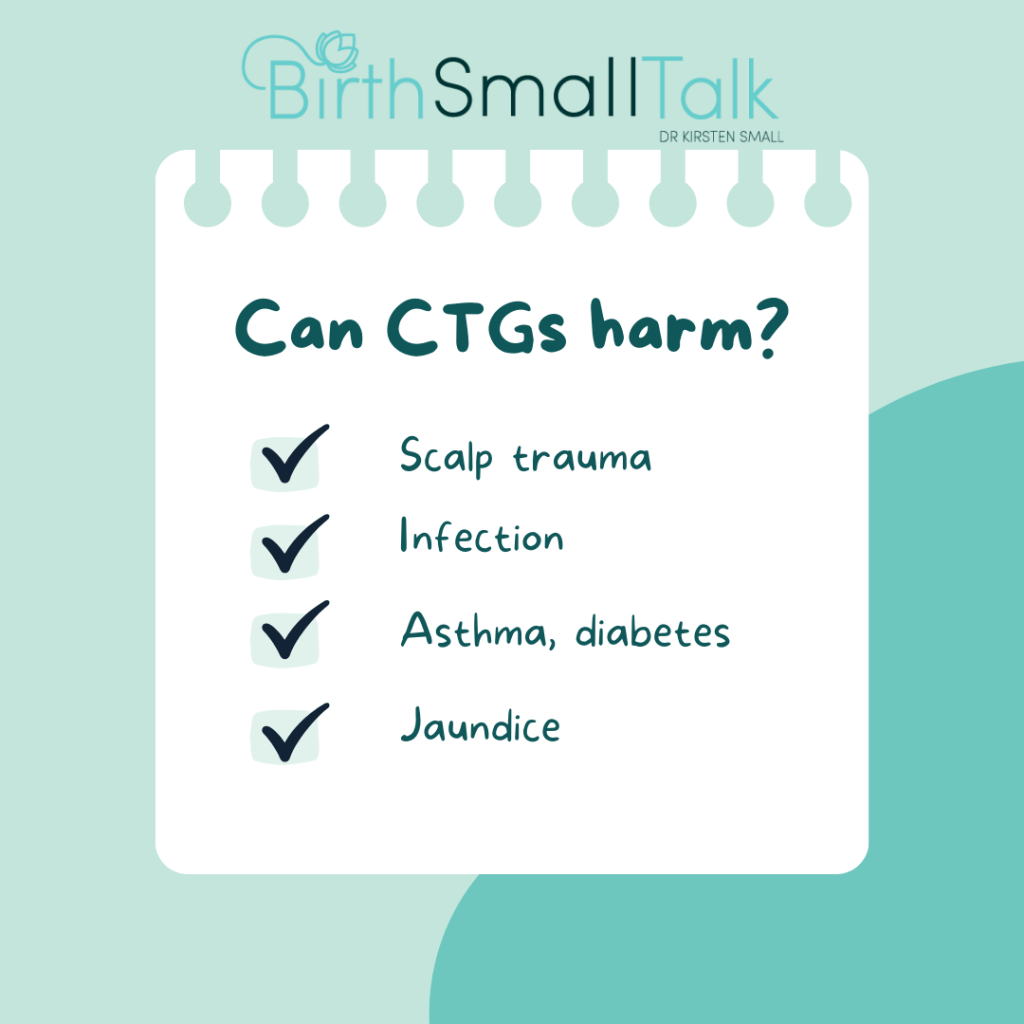
Early CTG researchers noted cases of scalp trauma (lacerations, haematoma formation) or infection (scalp abscess) occurring when a fetal electrode was used (Koh et al., 1975; Roux et al., 1970). More recent research (Kawakita et al, 2016) found three more cases of scalp trauma and one more case of cephalohaematoma (extensive bruising of the scalp) for every 1000 babies when a fetal spiral electrode had been used.
The Alfirevic review (2017) also found a threefold increase in scalp trauma and or infection when CTG monitoring was used. Serious, and sometimes fatal, skin infections like necrotising fasciitis can develop at the site where the fetal spiral electrode is attached (Davey & Moore, 2006; Hsieh, et al., 1999; Siddiqi & Taylor, 1982). Cases of intracranial abscess formation (Fick & Woerdeman, 2021) or sepsis (Kawakita et al., 2016) have been reported associated with the use of a fetal spiral electrode.
There are case reports where a fetal spiral electrode has been applied to the fetal face or eye (Lauer & Rimmer, 1998). A fetal death has even been reported when a fetal spiral electrode was screwed into the umbilical cord of a breech presenting fetus (de Leeuw et al., 2002). Knowing just how often these sorts of harms happen is challenging, as they have generally reported as individual case studies and no one has (yet) done a large study to see how often complications happen.
Concerns have been raised that the use of a fetal electrode might increase the transmission of group B streptococcus, human immunodeficiency virus, hepatitis B and C, and herpes from mother to baby (Murray, 2002). Koszalka and team (1982) examined the effects on neonatal infection when women were randomised to either intermittent auscultation or CTG monitoring with a fetal electrode. They found no difference in the overall rates of neonatal infection, however a much higher incidence of meningitis was noted among infants exposed to both a fetal electrode and to scalp blood sampling (7% of this group). Gill et al. (1997) found a significant increase in neonatal deaths from early onset group B streptococcal sepsis when infants with bacteriological evidence of colonisation had been monitored with a fetal spiral electrode during labour.
From the available data, it appears that there is a small, difficult to be exact about, risk of harm to the infant during intrapartum CTG monitoring when a fetal electrode used. While this risk can possibly be reduced through correct approaches to application and use of the electrode, screening of women for infectious diseases and giving prophylactic antibiotics, it can be avoided completely by not using CTG monitoring, or where this is in use, using external approaches to monitoring.
Risks of surgical birth
In part one of this series I reviewed the evidence showing CTG use in labour is associated with higher rates of caesarean and instrumental birth, and examined the consequences of this for birthing women. There are also consequences for babies. In the short-term, babies born by caesarean section during labour have higher rates of jaundice, feeding problems and hypothermia shortly after birth than those born vaginally (Peters et al., 2018). Caesarean born children also experience higher rates of health problems in later life. Conditions linked to caesarean birth are:
- respiratory and other infections, eczema, metabolic disorder (Peters et al., 2018),
- obesity (Li et al., 2012),
- asthma (Huang et al., 2014),
- type 1 diabetes (Cardwell et al., 2008),
- systemic connective tissue disorders, juvenile arthritis, inflammatory bowel disease, leukaemia (Sevelsted et al., 2015)
- altered immune function (Cho & Norman, 2013),
- neurological morbidity (particularly autism and movement disorders) (Baumfeld et al., 2018), and
- underachievement at school (Polidano et al., 2017).
Babies born with the assistance of either vacuum extraction or forceps can experience trauma related to the use of instruments. Use of the vacuum extractor is associated with a particular form of haemorrhage occurring under the surface of the scalp (cephalohaematoma), and this risk is greater when the procedure has been performed for an abnormal fetal heart rate pattern rather than a prolonged second stage of labour (Salman et al., 2017). While uncommon (an incidence of 1 in 413 births), the use of obstetrical forceps can cause trauma to the infant’s eye (McAnena et al., 2015).
Some births are complicated by difficulty achieving the birth of the shoulders after the baby’s head has been born, a condition known as shoulder dystocia. Instrument assisted births increase the risk of this complication (in comparison with non-instrumental vaginal birth) (Asta et al., 2016) and are associated with an increased incidence of nerve injury for the baby as a consequence of shoulder dystocia (Brimacombe et al., 2008).
Mirroring the findings for caesarean birth, instrumental birth has been associated with a higher incidence of jaundice, feeding problems, and hypothermia in the short term (Peters et al., 2018) along with a number of long term poor health outcomes. These include higher rates of asthma in adolescence (Hancox et al., 2013; Keski-Nisula et al., 2009), and higher rates of eczema, metabolic disorder and respiratory infections (Peters et al., 2018) in comparison with children born without the use of instrumental assistance.
Wrapping up
Not doing harm (illustrated by the Latin phrase primum non nocere [Smith, 2005]) is a core ethical principle in health care, requiring clinicians to ensure benefits clearly outweigh harms of any planned intervention. There is no doubt at all that there is limited benefit from the use of intrapartum CTG monitoring and clear evidence of harm. As clinicians in maternity care our discussions with women need to go well beyond “let’s just pop the monitor on to be on the safe side”. In order to begin having honest conversations with birthing women, we first need to start with honest conversations within our professions about the failure of CTG monitoring to delivery on its promises.
Sign Up for the BirthSmallTalk Newsletter and Stay Informed!
Want to stay up-to-date with the latest research and course offers? Our monthly newsletter is here to keep you in the loop.
By subscribing to the newsletter, you’ll gain exclusive access to:
- Exciting Announcements: Be the first to know about upcoming courses. Stay ahead of the curve and grab your spot before anyone else!
- Exclusive Offers and Discounts: As a valued subscriber, you’ll receive special discounts and offers on courses. Don’t miss the chance to save money while investing in your professional growth.
Join the growing community of birth folks by signing up for the newsletter today!
References
Alfirevic, Z., Devane, D., Gyte, G. M. L., & Cuthbert, A. (2017). Continuous cardiotocography (CTG) as a form of electronic fetal monitoring (EFM) for fetal assessment during labour. Cochrane Database of Systematic Reviews, 2,(CD006066), 1-137. https://doi.org/10.1002/14651858.CD006066.pub3
Asta, A. D., Ghi, T., Pedrazzi, G., & Frusca, T. (2016). Does vacuum delivery carry a higher risk of shoulder dystocia? Review and meta-analysis of the literature. European Journal of Obstetrics, Gynecology, and Reproductive Biology, 204, 62-68. https://doi.org/10.1016/j.ejogrb.2016.07.506
Baumfeld, Y., Sheiner, E., Wainstock, T., Segal, I., Sergienko, R., Landau, D., & Walfisch, A. (2018). Elective cesarean delivery at term and the long-term risk for neurological morbidity of the offspring. American Journal of Perinatology, 35(11), 1038-1043. https://doi.org/10.1055/s-0038-1637001
Brimacombe, M. M., Iffy, L. L., Apuzzio, J. J., Varadi, V. V., Nagy, B. B., Raju, V. V., & Portuondo, N. N. (2008). Shoulder dystocia related fetal neurological injuries: the predisposing roles of forceps and ventouse extractions. Archives of Gynecology and Obstetrics, 277(5), 415-422. https://doi.org/10.1007/s00404-007-0465-7
Cardwell, C. R., Stene, L. C., Joner, G., Cinek, O., Svensson, J., Goldacre, M. J., Parslow, R. C., Pozzilli, P., Brigis, G., Stoyanov, D., Urbonaitė, B., Šipetić, S., Schober, E., Ionescu-Tirgoviste, C., Devoti, G., de Beaufort, C. E., Buschard, K., & Patterson, C. C. (2008). Caesarean section is associated with an increased risk of childhood-onset type 1 diabetes mellitus: a meta-analysis of observational studies. Diabetologia, 51(5), 726-735. https://doi.org/10.1007/s00125-008-0941-z
Cho, C. E., & Norman, M. (2013). Cesarean section and development of the immune system in the offspring. American Journal of Obstetrics and Gynecology, 208(4), 249-254. https://doi.org/10.1016/j.ajog.2012.08.009
Davey, C., & Moore, A. (2006). Necrotizing fasciitis of the scalp in a newborn. Obstetrics & Gynecology, 107(2), 461-463. https://doi.org/10.1097/01.AOG.0000164094.02571.77
de Leeuw, J. P., de Haan, J., Derom, R., Thiery, M., Martens, G., & van Maele, G. (2002). Mortality and early neonatal morbidity in vaginal and abdominal deliveries in breech presentation. Journal of Obstetrics and Gynaecology, 22(2), 127-139. https://doi.org/10.1080/0144361012023256
Fick, T., & Woerdeman, P. A. (2021, Apr 6). Neonatal brain abscess development following fetal scalp electrode placement: a rare complication. Child’s Nervous System, 38(1), 199-202. https://doi.org/10.1007/s00381-021-05150-7
Gill, P., Sobeck, J., Jarjoura, D., Hillier, S., & Benedetti, T. (1997). Mortality from early neonatal Group B Streptococcal sepsis. Journal of Maternal-Fetal and Neonatal Medicine, 6(1), 35-39. https://doi.org/10.3109/14767059709161949
Grivell, R., Alfirevic, Z., Gyte, G., Devane, D. (2015). Antenatal cardiotocography for fetal assessment. Cochrane Database of Systematic Reviews, 9, CD007863. https://dx.doi.org/10.1002/14651858.cd007863.pub4
Hancox, R. J., Landhuis, C. E., & Sears, M. R. (2013). Forceps birth delivery, allergic sensitisation and asthma: a population-based cohort study. Clinical and Experimental Allergy, 43(3), 332-336. https://doi.org/10.1111/j.1365-2222.2012.04058.x
Haverkamp, A. D., Thompson, H. E., McFee, J. G., & Cetrulo, C. (1976). The evaluation of continuous fetal heart rate monitoring in high-risk pregnancy. American Journal of Obstetrics and Gynecology, 125(3), 310-320.
Hsieh, W-S., Yang, P-H., Chao, H-C., & Lai, J-Y. (1999). Neonatal necrotizing fasciitis: A report of three cases and review of the literature. Pediatrics, 103(4),e53. DOI: 10.1542/peds.103.4.e53
Huang, L., Chen, Q., Zhao, Y., Wang, W., Fang, F., & Bao, Y. (2014, Aug 19). Is elective cesarean section associated with a higher risk of asthma? A meta-analysis. Journal of Asthma, 52(1), 16-25. https://doi.org/10.3109/02770903.2014.952435
Kawakita, T., Reddy, U. M., Landy, H. J., Iqbal, S. N., Huang, C.-C., & Grantz, K. L. (2016, Oct). Neonatal complications associated with use of fetal scalp electrode: a retrospective study. BJOG: An International Journal of Obstetrics and Gynaecology, 123(11), 1797-1803. https://doi.org/10.1111/1471-0528.13817
Keski-Nisula, L., Harju, M., Järvelin, M. R., & Pekkanen, J. (2009). Vacuum-assisted delivery is associated with late-onset asthma. Allergy, 64(10), 1530-1538. https://doi.org/10.1111/j.1398-9995.2009.02044.x
Koh, K. S., Greves, D., Yung, S., & Peddle, L. J. (1975). Experience with fetal monitoring in a university teaching hospital. Canadian Medical Association Journal, 112(4), 455-456- 459-460.
Koszalka, M. F., Haverkamp, A. D., Orleans, M., & Murphy, J. (1982, Oct 01). The effects of internal electronic fetal heart rate monitoring on maternal and infant infections in high-risk pregnancies. Journal of Reproductive Medicine, 27(10), 661-665. https://www.ncbi.nlm.nih.gov/pubmed/7175837
Lauer, A. K., & Rimmer, S. O. (1998, May). Eyelid laceration in a neonate by fetal monitoring spiral electrode. American Journal of Ophthalmology, 125(5), 715-717. https://doi.org/10.1016/s0002-9394(98)00035-x
Li, H., Zhou, Y., & Liu, J. (2012). The impact of cesarean section on offspring overweight and obesity: a systematic review and meta-analysis. International Journal of Obesity, 37(7), 893-899. https://doi.org/10.1038/ijo.2012.195
Lupton, D. A. (2013a). Precious, pure, uncivilised, vulnerable: Infant embodiment in Australian popular media. Children & Society, 28(5), 341-351. https://doi.org/10.1111/chso.12004
Lupton, D. A. (2013b). ‘It’s a terrible thing when your children are sick’: Motherhood and home healthcare work. Health Sociology Review, 22(3), 234-242. http://pubs.e-contentmanagement.com/doi/abs/10.5172/hesr.2013.22.3.234
McAnena, L., O’Keefe, M., Kirwan, C., & Murphy, J. (2015, Nov). Forceps delivery-related ophthalmic injuries: A case series. Journal of Pediatric Ophthalmology and Strabismus, 52(6), 355-359. https://doi.org/10.3928/01913913-20151014-50
Murray, L. (2002). Fetal scalp electrode use in practice. British Journal of Midwifery, 10(8), 498-504. https://doi.org/10.12968/bjom.2002.10.8.10598
Peters, L. L., Thornton, C., de Jonge, A., Khashan, A. S., Tracy, M. B., Downe, S., Feijen-de Jong, E. I., & Dahlen, H. G. (2018). The effect of medical and operative birth interventions on child health outcomes in the first 28 days and up to 5 years of age: A linked data population-based cohort study. Birth, 11, 347-357. https://doi.org/10.1111/birt.12348
Polidano, C., Zhu, A., & Bornstein, J. C. (2017). The relation between cesarean birth and child cognitive development. Scientific Reports, 7(1), 11483. https://doi.org/10.1038/s41598-017-10831-y
Roux, J. F., Yeni-Komshian, H., Wilson, R., Jassani, M., & Jordan, J. (1970, Dec). Labor monitoring. A practical experience. Obstetrics & Gynecology, 36(6), 875-880. https://www.ncbi.nlm.nih.gov/pubmed/5487738
Salman, L., Aviram, A., Krispin, E., Wiznitzer, A., Chen, R., & Gabbay-Benziv, R. (2017). Adverse neonatal and maternal outcome following vacuum-assisted vaginal delivery: does indication matter? Archives of Gynecology and Obstetrics, 295(5), 1145-1150. https://doi.org/10.1007/s00404-017-4339-3
Sevelsted, A., Stokholm, J., Bønnelykke, K., & Bisgaard, H. (2015). Cesarean section and chronic immune disorders. Pediatrics, 135(1), e92-98. https://doi.org/10.1542/peds.2014-0596
Siddiqi, S. F., & Taylor, P. M. (1982). Necrotizing fasciitis of the scalp. American Journal of Diseases of Children, 136, 226-228.
Smith, C. M. (2005). Origin and uses of primum non nocere–above all, do no harm!. Journal of Clinical Pharmacology, 45(4), 371-377. https://doi.org/10.1177/0091270004273680
- Can CTGs harm? Part 2
- Smart surveillance and the caesarean section rate: Have they cracked the code?
Categories: Basics, CTG, EFM, IA
Tags: caesarean section, Cerebral palsy, Fetal spiral electrode, FSE, Group B Streptococcus, instrumental birth, trauma
12 replies ›
Trackbacks
- Does antenatal CTG monitoring save lives? – Birth Small Talk
- Fetal monitoring and cord clamping: What’s the link? – Birth Small Talk
- Twenty fetal monitoring myths that won’t go away – Birth Small Talk
- Can CTGs harm? Part 1 – Birth Small Talk
 Birth Small Talk
Thanks Kirsten.
Enjoying reading your insights a lot.
LikeLike
Thanks Tess. Glad you are enjoy them.
LikeLike
Thankyou very informative
LikeLike
Thank you Kirsten. Really valuable to get this perspective made so accessible from an Obgyn – will definitely be sharing with clients. I do have one small comment on the info presented from the Alfirevic review on scalp injury where there is a ‘threefold increase’, as I’ve been led to be wary of info presented as relative risk rather than absolute risk.
LikeLike
Hi Sarah, you are correct that it is better to give absolute risk numbers rather than relative risk. The incidence of scalp trauma in babies born to women randomised to CTG monitoring was 1%.
LikeLiked by 1 person
Thank you for these. What are the perceived, or otherwise, benefits to using CTG intrapartum? It’d be good to be able to weigh these up against the benefits to help women make informed decisions.
LikeLiked by 1 person
I meant weigh these up against the risks!
LikeLiked by 1 person
There’s a widespread belief that intrapartum CTG monitoring prevents death or long term brain injury. The evidence we have shows this isn’t the case however.
LikeLiked by 1 person