
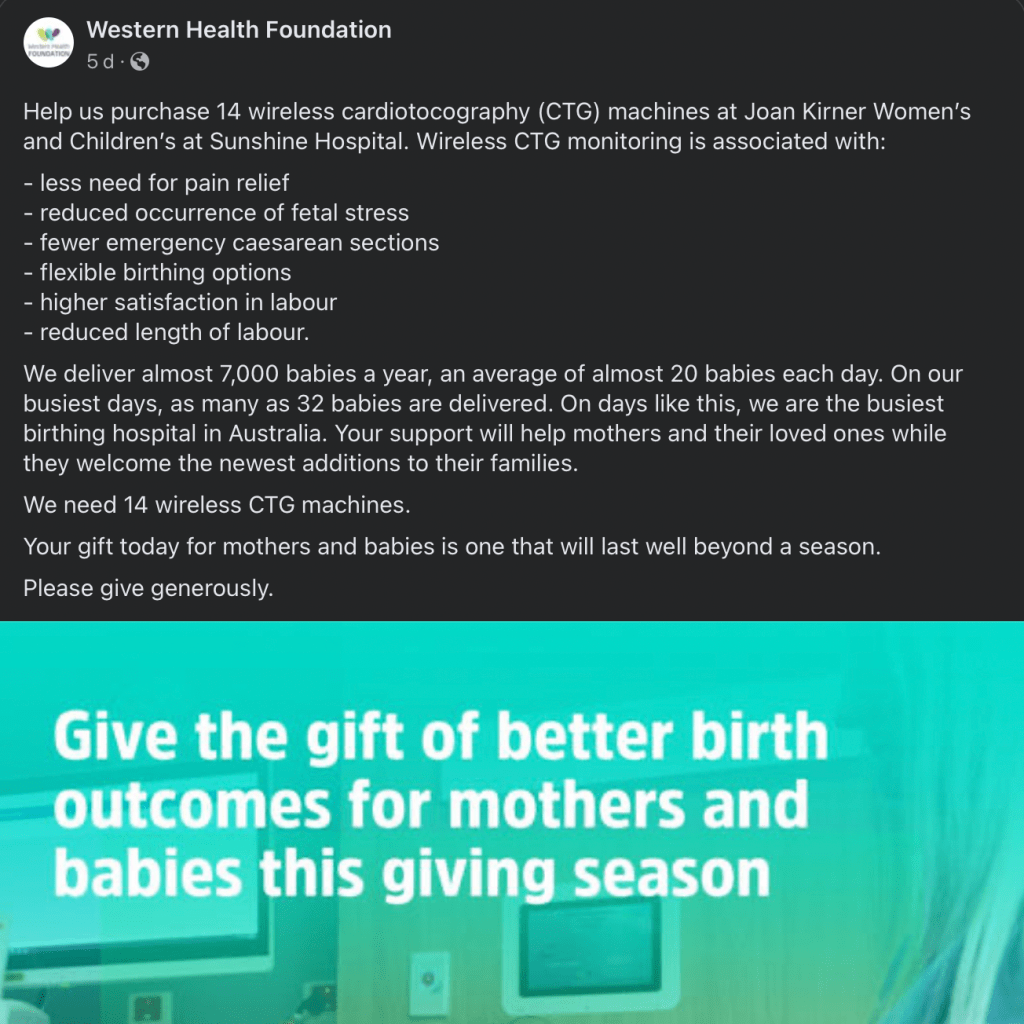
I was all set to have a few weeks away from blog writing, when this Facebook post appeared over the weekend. I feel compelled to set out some actual facts about telemetry CTG monitoring to counter the claims made in this request for donations. Then I’m going to take a few weeks off!
What is telemetry CTG monitoring?
Standard CTG technology uses wires to connect the sensors on the woman’s body with the CTG machine. Telemetry systems build a small transmitter into the sensor. This sends the collected information to the CTG machine without requiring a physical connection with the machine. Many telemetry sensors have the added advantage of being waterproof so they can be used in the shower or with water immersion during labour.
What does the evidence actually say?
Do telemetry CTG monitors improve outcomes? The first question to ask here – is compared to what, exactly?
When compared with intermittent auscultation, CTG use makes no difference to the rate of death or long term brain injury. There is an increase in the use of caesarean section and instrumental birth with CTG use, and no difference in the use of epidural analgesia or other forms of medication used to manage pain. The use of oxytocin to speed up labour was also not different.
I have a sense that what was intended by the author of this post was, however, to compare telemetry CTG monitoring with standard wired monitoring. There has never been a randomised controlled trial comparing the two. There is, to the best of my knowledge (and I have specifically searched the literature), only one piece of research that comes close to helping out here. This research was reported in 2022 in a paper by Watson and colleagues. If you were going to make claims about what telemetry could achieve, this would be the best place to go for evidence.
Watson and colleagues collected information about 74 women women who used telemetry monitoring during labour and 87 women who used standard CTG monitoring. Some women specifically requested telemetry use, others had it offered by the midwife caring for them. As the use of telemetry was not a random assignment, it is entirely possible some or all of the findings of the study relate factors that were different between women who used telemetry and those who did not.
Taking the health services’ claims one by one:
- Wireless CTG use reduces the “need for pain relief”: epidurals were used by 39% of women with telemetry and 46% of women with wired CTG monitoring. 45% of women using telemetry used an opioid medication (like pethidine) for pain compared to 39% with standard CTG monitoring. 88% of women using telemetry used nitrous oxide, and this was 78% with standard CTG use. So this is a mixed bag – epidural rates were lower but other pain medications were used more often.
- “Reduced occurrence of fetal stress”: I’m going to assume this is meant to refer to the incidence of abnormal fetal heart rate patterns. (I doubt the fetus is feeling stressed about climate change.) There is absolutely no evidence at all to back up this claim.
- “Fewer emergency caesarean sections”: In Watson’s study the emergency caesarean section rate was 22% for women using telemetry and 14% for women using standard CTGs. So, yeah, nah – as we say in Australian. The evidence doesn’t back this one up.
- “Flexible birthing options”: I’m not at all sure what this is meant to mean. I’m going to go with birth positions for non-instrumental vaginal birth. In Watson’s study, 70% of women who used telemetry gave birth on the bed or in lithotomy position and this was 88% for those using standard CTGs. So, the rates of birth off the bed, including in water, were low in both groups but marginally higher with telemetry. So this one is a maybe, if you squint a bit, and the angle of the light is just right.
- “Higher satisfaction in labour”: Women in Watson’s study completed the Satisfaction with Childbirth questionnaire. There were no differences in mean satisfaction scores. So – another completely untrue claim.
- “Reduced length of labour”: The average length of the first stage of labour was 5.0 hours for women using telemetry and 4.4 hours for women using standard CTGs. For the second stage of labour, the times were 1.4 and 0.9 hours respectively. So labour was longer for women using telemetry. Again – another untrue claim.
Watson’s study did show that women who used telemetry were significantly more likely to spend more time off the bed during labour than women using standard CTG monitoring – the only proven benefit from wireless telemetry. And yet, the authors of this advertising campaign didn’t mention it!
So…
Hospitals can fund raise for whatever they want. I have no particular issue with them fundraising for fetal monitoring equipment, even if I think spending the money on other things would ultimately have a bigger impact on outcomes. But promising people that their donation will achieve things that are just not true? Well, that’s not ok. Before you go making claims about bits of equipment, get the facts right.
I have a specific lesson in my Fetal Monitoring for Maternity Professionals course that covers the evidence about telemetry. And there are lessons about pretty much every other aspect of fetal heart rate monitoring in labour that a maternity professional really should know before they provide care to women in labour. If you work for Western Health, drop me an email with a photo of your staff ID, and I’ll give you 50% off a course in 2024. It’s time to stop the cycle of ignorance.
UPDATE
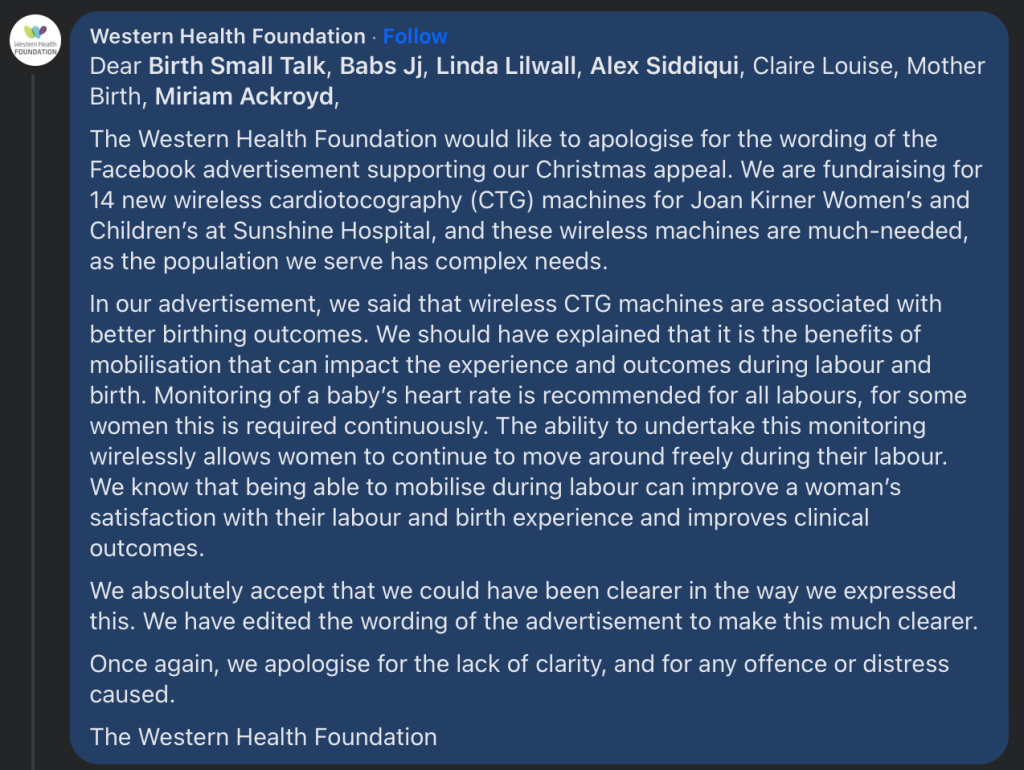
Western Health have posted an apology on their facebook post. It reads:
Sign Up for the BirthSmallTalk Newsletter and Stay Informed!
Want to stay up-to-date with the latest research and course offers? Our monthly newsletter is here to keep you in the loop.
By subscribing to the newsletter, you’ll gain exclusive access to:
- Exciting Announcements: Be the first to know about upcoming courses. Stay ahead of the curve and grab your spot before anyone else!
- Exclusive Offers and Discounts: As a valued subscriber, you’ll receive special discounts and offers on courses. Don’t miss the chance to save money while investing in your professional growth.
Join the growing community of birth folks by signing up for the newsletter today!
References
Watson, K., Mills, T. A., & Lavender, T. (2022, May). Experiences and outcomes on the use of telemetry to monitor the fetal heart during labour: findings from a mixed methods study. Women and Birth, 35(3), e243-e252. https://doi.org/10.1016/j.wombi.2021.06.004
Tags: caesarean section, epidural, facts, pain, telemetry
 Birth Small Talk
Hello K, Thank you so much for shining a light
LikeLike
You are welcome! I’m tired of reading nonsense…
LikeLike
Oh dear, your arguments then could be used as an excuse to keep women on the bed! Actually, it might be better to keep them away from the tech environment altogether, give them suitable furniture – sofas, bean bags, worktops, birth pools, wall bars, kneeling mats …. why are these things rarely available in hospitals?
LikeLiked by 1 person
I forgot to say Thank you for all your work for us over the years and have a very Happy Christmas!
LikeLike
You too Margaret!
LikeLike
Oh well, that’s just the question I needed to be answered! Thank you so much ❤ have a great 2024! And I really hope people will use this disscout offer 🙂
LikeLike
Thanks Anna, I’m glad it was useful. There’s a really HUGE discount about to drop next week for people who are newsletter subscribers.
LikeLiked by 1 person
Hi Kirsten I wanted to reach out to you again. Firstly, I wanted to Thank you for teaming up with Melanie and putting together the ongoing PDs for endorsed midwives. I really look forward to completing the series. There’s been many changes in my world, one of them being that I have moved up to Cairns and am currently working in the hospital. Not the long term plan, but I’m here for the present. I was having a discussion about your Phd work in the CTG world, your course, etc and I was asked if I wanted to do a write up/bio/ariticle on you and this for our monthly Midwivery News newletter. I wanted to ask if you would be willing to be interviewed, or perhaps I can drop a few “interview” questions you could answer. For some reason, there a not very many up in FNQ who know of your work. Time to spread the word. Thanks for your time. Cheers Marg
On Tue, Dec 19, 2023 at 2:09â¯PM margaret sommeling < mesmerisedmamas@gmail.com> wrote:
LikeLike
Drop me an email Marg and I’ll see what I can do depend on your timeline. Info@birthsmalltalk.com
LikeLike
Thanks for your amazingly prompt reply.
The next newsletter come out in August, however I do appreciate busy schedules. I’m very good at cramming a lot in, so even for September newsletter.
I’ll formulate some questions and send them through.
Is it best to continue on this thread?
Thanks so much, you a very generous to be willing to consider this.
Cheers Marg
LikeLike
Email me instead Marg.
LikeLike