
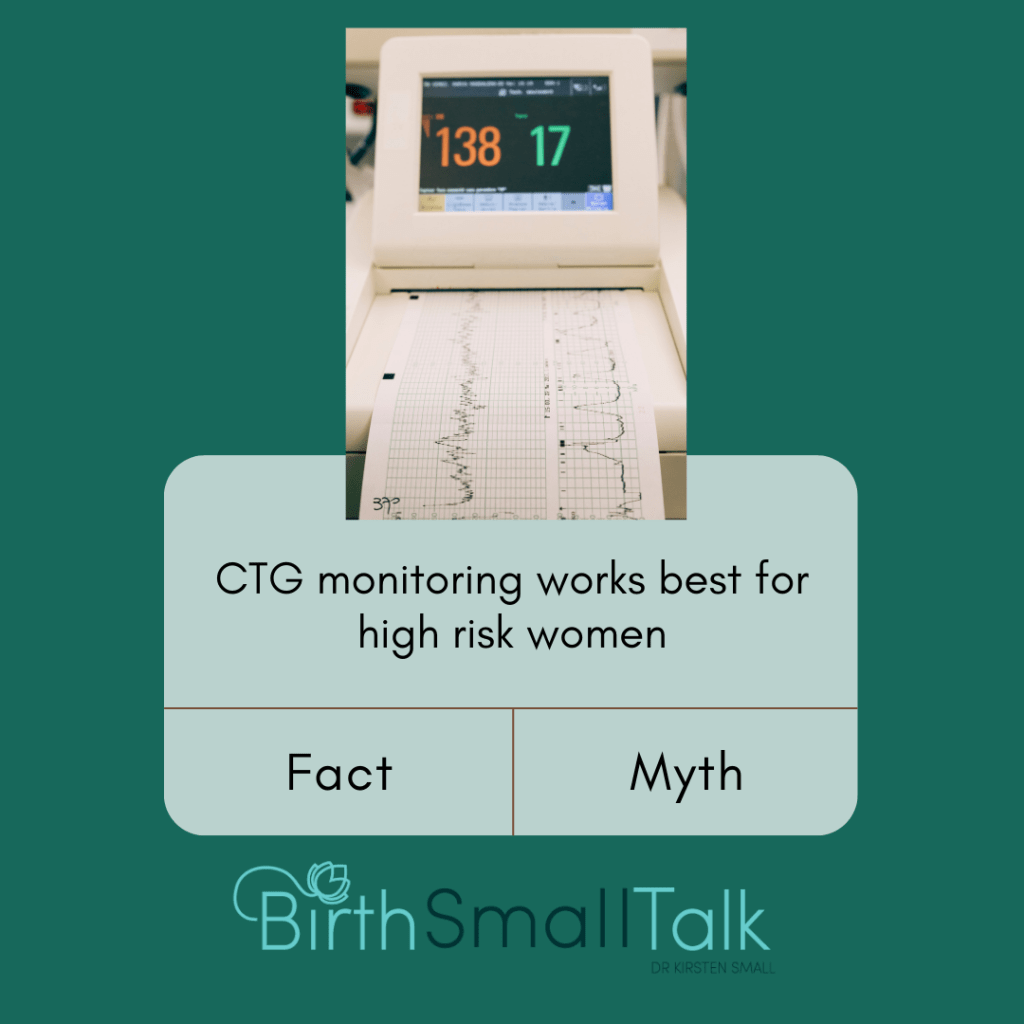
One of the goals I set myself during my PhD years was to read, and understand, pretty much everything that had been published on CTG monitoring. I started collecting and reading papers about two years before I enrolled. I began by getting copies of the original papers included in the Cochrane review. That was eye-opening. The research showed no benefit from CTG use.
As I have spoken with obstetricians and midwives about the evidence, many are quite sure that I have read this research all wrong. Some are very sure that CTG use improves outcomes for women with risk factors. This surety about the evidence is curious given that the Cochrane review (Alfirevic et al., 2017) has always included information from randomised controlled trials about the use of CTG monitoring in women considered to be at higher risk. The Cochrane review said that CTG use was no better than intermittent auscultation, even back to when it was the book called Effective Care in Pregnancy and Childbirth. It seemed to me that this information was hidden in plain sight.
Why I wanted to write this paper
So I decided I needed to do something about this – and wrote what became the first paper published as part of my PhD work. My first motivation for wanting to write this paper was to pull the research about high-risk populations out from where it was buried in Cochrane review and make it more visible.
And I wanted to go further than this. The RANZCOG guidelines suggest that evidence from types of research other than randomised controlled trials show CTG use is the better choice for women with risk factors (Royal Australian and New Zealand College of Obstetricians and Gynaecologists, 2019). Somewhat tellingly, the evidence they gave for this statement was a randomised controlled trial (MacDonald et al., 1985). The second paper they mentioned was about the use of particular approaches to data analysis, that questions whether it might be possible to prove that CTGs work if you do the right sort of analysis. (Hornbuckle et al., 2000). Neither of these is actual research proof that CTG monitoring is superior for women with risk factors.
Over and over again during my professional life I had heard that CTGs worked. I wanted to find out for myself whether there really was a big pile of research showing better outcomes from CTG use, that was done in ways other than using a randomised controlled trial.
What we found
My PhD supervisors as co-authors were on board with the plan for the paper, so I (with the help of the excellent librarians at Griffith University) set about finding all the original research and making quality assessments. We started with a re-analysis of the same evidence included in the Cochrane review – all the randomised controlled trials including women considered to be at high risk. Not surprisingly given the skills of the Cochrane team, we found the same that they did: no improvement in mortality and an increase in cerebral palsy rates when CTG monitoring rather than intermittent auscultation is used in high risk populations.
We moved to looking at the non-experimental research, focussing on research that included women considered to be at high risk. We didn’t attempt to summarise the findings of all the non-experimental research with a single relative risk calculation (as we had for the randomised controlled trials), as there was far too much variability within the research for this to be meaningful.
None of this research reported on cerebral palsy as an outcome.
There wasn’t much space in the paper to discuss the findings from non-experimental research, so let me share a few thoughts that didn’t make it into the article. (I haven’t reproduced table 1 here for copyright reasons, but you can find it in the paper.) We found a total of 26 non-experimental research projects, some published over more than one paper. Of these, 20 were at critical risk of bias according to the ROBINS-I tool. That is, the possibility that the findings were due to something other than the form of heart rate monitoring that was used was very high.
Of the papers in the critical risk category, 15 compared outcomes from a period prior to the introduction of CTG monitoring with a period after CTG monitoring was introduced. These studies were published between 1972 and 1982. Three compared the use of intermittent auscultation in a low risk population with CTG use in a high-risk population, and the remaining two papers compared intermittent auscultation in a high-risk population with CTG use in a high-risk population. Only four of the 26 studies found a statistically significant reduction in stillbirth, four found a significant reduction in neonatal mortality, and five found a significant reduction in the overall perinatal mortality rate. One study found a statistically significant increase in neonatal death when CTGs were introduced. The risk ratios for perinatal mortality ranged from 0.10 (a 90% reduction in deaths) to 1.56 (a 56% increase in deaths). So even in this body of literature at high risk of bias – there’s no strong signal that CTGs are the better option.
Five studies were considered to be at moderate risk of bias according to ROBINS-I. This evidence is considered by the makers of the ROBINS-I tool to be sufficiently robust to guide practice. These five were conducted between 1978 and 2018, with the largest including 1.2 million women. Two studies compared the use of intermittent auscultation with CTG use in a high-risk population, neither finding significant benefits. The remaining three studies examined large population data sets comparing the use of intermittent auscultation with CTGs, having corrected for known confounders. One found a statistically significant increase in neonatal deaths with CTG use, with a risk ratio of 1.46. The others found no statistically significant differences.
What does all that mean?
Having examined ALL the research, what is clear is that there is no compelling evidence that CTG use improves long term outcomes for the babies of women considered to be at high risk. It is well past time maternity professionals were having honest conversations about this.
Sign Up for the BirthSmallTalk Newsletter and Stay Informed!
Want to stay up-to-date with the latest research and course offers? Our monthly newsletter is here to keep you in the loop.
By subscribing to the newsletter, you’ll gain exclusive access to:
- Exciting Announcements: Be the first to know about upcoming courses. Stay ahead of the curve and grab your spot before anyone else!
- Exclusive Offers and Discounts: As a valued subscriber, you’ll receive special discounts and offers on courses. Don’t miss the chance to save money while investing in your knowledge development.
Join the growing community of BirthSmallTalk folks by signing up for the newsletter today!
References
Alfirevic, Z., Devane, D., Gyte, G. M. L., & Cuthbert, A. (2017, Feb 03). Continuous cardiotocography (CTG) as a form of electronic fetal monitoring (EFM) for fetal assessment during labour. Cochrane Database of Systematic Reviews, 2(CD006066), 1-137.
Hornbuckle, J., Vail, A., Abrams, K. R., & Thornton, J. G. (2000, Jan). Bayesian interpretation of trials: the example of intrapartum electronic fetal heart rate monitoring. BJOG: An International Journal of Obstetrics and Gynaecology, 107(1), 3-10.
MacDonald, D., Grant, A., Sheridan-Pereira, M., Boylan, P. C., & Chalmers, I. (1985, Jul 01). The Dublin randomized controlled trial of intrapartum fetal heart rate monitoring. American Journal of Obstetrics and Gynecology, 152(5), 524-539.
Royal Australian and New Zealand College of Obstetricians and Gynaecologists. (2019). Intrapartum fetal surveillance clinical guideline. 4th Edn.
Small, K. A., Sidebotham, M., Fenwick, J., & Gamble, J. (2020, Sept). Intrapartum cardiotocograph monitoring and perinatal outcomes for women at risk: Literature review. Women and Birth, 33(5), 411-418.
Categories: CTG, EFM, IA, Perinatal brain injury, Perinatal mortality, Reflections
Tags: Evidence, guidelines, Literature review
11 replies ›
Trackbacks
- Does CTG monitoring during labour work? – Birth Small Talk
- Exploring risk: making the argument for intrapartum CTG monitoring – Birth Small Talk
- There’s an invisible human rights issue in maternity care – let’s talk about it – Birth Small Talk
- Twenty fetal monitoring myths that won’t go away – Birth Small Talk


Arresting information. Thank you for this informed, robust explanation of the evidence. Reminds me of the Breech Trial, which also was found to be very poor quality and certainly not to be used to change practice. There is a huge blind spot in obstetric practice and it involves not seeing what you don’t waht to see. So glad you are sharing this information.
LikeLike
Thanks Carolyn. The challenge is to get the right people to listen. I hope that this is a good start in that direction.
LikeLike
The thing is, I have heard doctors hark on about evidence based practice yet when it comes to pet habits or rituals of the ob/gyn kind this same argument seems to become ‘because I say so’ rather than being evidence based. I have worked with both midwives and doctors who are grimly attached to their CTG, but I feel that it is more about defensive medicine than anything else.
Here’s to breaking through!
LikeLike
Indeed!
LikeLike
WHO agrees – Despite its widespread use, there is still no evidence to justify the use of continuous electronic foetal monitoring (EFM) for low-risk women as the risk of interventions increases despite a lack of demonstrable impact on perinatal mortality (Z. Alfirevic, D. Devane, G.M. Gyte, A. CuthbertContinuous cardiotocography (CTG) as a form of electronic fetal monitoring (EFM) for fetal assessment during labour Cochrane Database Syst Rev, 2 (2017), p. CD006066)
LikeLike
Hi Ellen, Thanks for your comment. WHO agrees that there is no evidence for CTG use for low-risk women, but says nothing about high-risk women. If they simply removed the phrase “for low-risk women” then their statement would be complete and accurate. That someone deliberately chose to include that phrase speaks volumes.
LikeLike
Astonishing! How often have I wondered about my true motivations for just not wanting to put ‘risky’ women on a CTG – turns out my midwife heart is not ‘dangerous’. Thank you, thank you, thank you for bringing this to our attention. Now I am armed!
LikeLike