
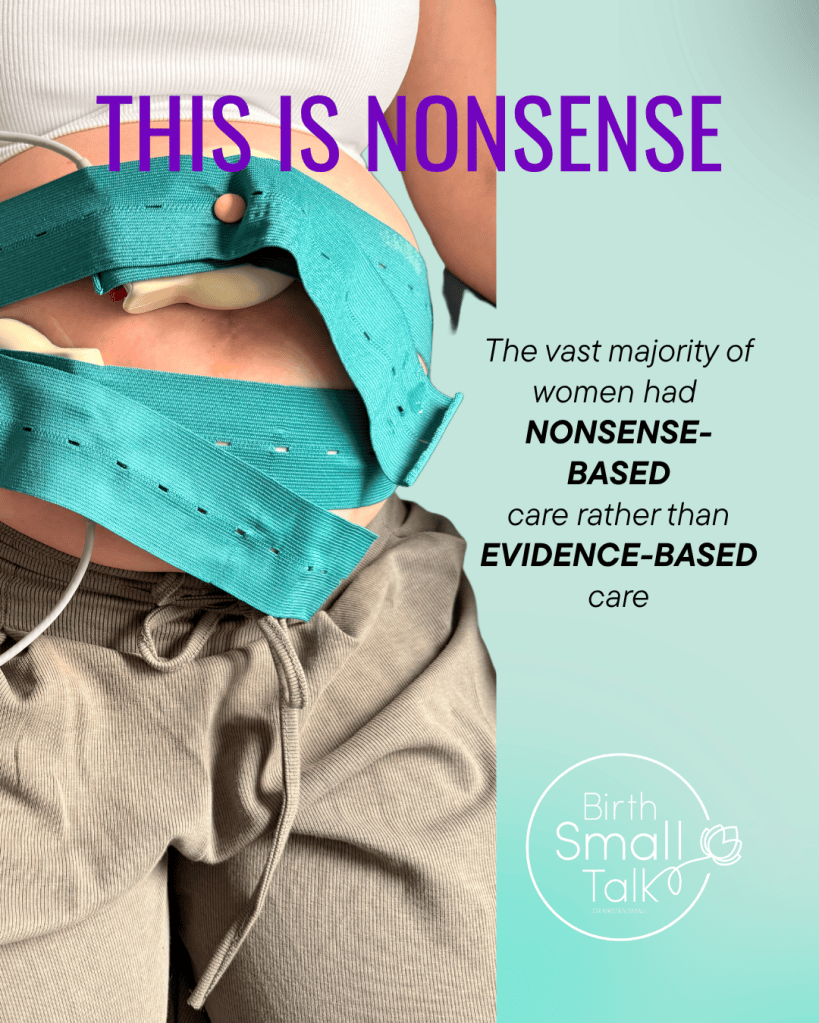
I started my book Monitoring Your Baby in Labour with the statement that “CTGs are nonsense!”. I thought hard about whether to keep that phrase or not, knowing that some might criticise it as “rage baiting”. I kept it, because it reflects the reality of how I see CTGs being used in clinical practice in nonsensical ways. German research has just been published that provides yet another example of nonsense-based, rather than evidence-based CTG use (Hurtle et al., 2026).
What did the researchers do?
The research team wanted to measure the extent to which the use of ultrasounds and CTGs during pregnancy (not labour) matched with the German Maternity Directives. The Directives include no advice to use antenatal CTG monitoring for low-risk women. They also wanted to see whether women who had more CTGs and / or scans were more likely to give birth by caesarean section. While the findings about ultrasounds are interesting in themselves, I’m not going to explore them here. (The study is linked below if you want to read it to see what it says about scans.)
They retrospectively analysed billing data from the national health insurance scheme for women who gave birth between 2020 and 2022. The Directives set out the criteria that are considered to identify women with “increased need for monitoring” (or high-risk) and these are laid out in table 1. They include diabetes, hypertension, gestation > 40 weeks, multiple pregnancy, suspected fetal growth restriction, maternal age over 35 in first time births, bleeding, and a previous pregnancy loss. This split their population up into a low-risk group (24,679 women) and a high-risk group (142,313). The title of the study suggests they only looked at what happened for low-risk women, but they provided results for both groups.
They also used billing data to find out how many ultrasounds and / or CTGs were done per woman (there is a billing code for this) and how they gave birth. This gets around the issue of someone forgetting the details when asked in a survey some time after birth, but requires that each procedure was actually billed when it was done.
What did they find?
For women considered low-risk, the average (mean) number of antenatal CTGs per woman was 4.9. The number ranged from none to a whopping 25! Assuming the first CTG was done at 24 weeks, you would need to have three CTGs each fortnight to have 25 over the course of a pregnancy. That’s a vast amount for someone with a low-risk pregnancy, and a huge time commitment for the woman. Only 18% of women had no CTG performed.
For women considered high-risk, the average (mean) number of antenatal CTGs per woman was 7.1. The range was zero (2% of women) to 92. The authors provide no statistical measure to tell us whether this was significantly different to the numbers for low-risk women.
Looking at how women gave birth: for low-risk women who had no antenatal CTGs the caesarean section rate was 3.4%, while for those who had at least one CTG it was 20.1% – the difference was statistically significant. For high-risk women the numbers looked quite different. With no CTG use the caesarean section rate was 46.5% while with CTG use it was 33.5% (again a significant difference).
Important take home message 1: Nonsense-based CTG use
First, let’s come back to my point that this paper provides evidence of nonsense-based CTG use. What evidence do we have about antenatal CTG use for women considered to be low risk?
None.
It’s never been considered in a clinical trial. We don’t know what the potential harms and benefits are, as no one has ever gone looking for them. Using CTGs for this population is nonsense-based as it is entirely based on wishes and hopes that something useful is gained and nothing harmful happens.
What evidence do we have about antenatal CTG use for women who have a risk factor? There is a Cochrane review, summarising four randomised controlled trials. (Here’s my blog post with the full explanation of the findings.) The findings do NOT show that there were better outcomes for babies when CTGs were used in planning care for women with risk factors.
Once again, it is people’s nonsensical beliefs about the unproven wonderfulness of CTG use that drives practice, not the evidence.
Important take home message 2: Using CTGs like this is human rights abuse
It is simply impossible that every German woman who had been informed that there is nothing to suggest that having a CTG during pregnancy makes anything better would agree to have one of them, let alone five, 25, or 92 of them! The study’s authors comment on this in the discussion, highlighting findings from a study they had previously conducted. In that study 91% of women said they believed that CTG monitoring was a necessary part of care. The authors note how: “the information provided to the women likely did not include what is specified by the directives, the guidelines, and the Patient’s Rights Act”.
CTG use is a choice. Maternity professionals decide whether and when to offer CTG monitoring. Professionals are legally obligated to provide accurate information and make space for voluntary decision to occur. Only the woman has the legal authority to decide whether to accept the offer of a CTG or not.
Clearly, there is widespread acceptance that it is completely fine and normal to disempower women so they don’t know there is a decision to be made. And widespread acceptance that there is no need to provide any information or any accurate information to support women to make that decision. As my mother would have said: “just because everyone else is doing it, it doesn’t make it the right thing to do!”.
Important take home message 3: CTGs aren’t causing caesarean sections
In this study, there’s nothing to suggest that the use of antenatal CTG monitoring was the cause of the higher caesarean section rate in low-risk women. The authors knew this and they said so: “this analysis only shows a correlation between unnecessary diagnostic measures and a higher number of caesarean sections in healthy women”. Their conclusion shows what they think is going on: “An excessive focus on risks can lead to an overuse of diagnostic measures and result in potentially harmful interventions.”
I think this is a reasonable assumption about what the link is in this study. Care providers who see pregnancy and birth as inherently risky are both more likely to use CTG monitoring as a way to attempt to feel more in control of those risks and to see caesarean section as a safer option than vaginal birth. Care providers who tell women that they have to have a CTG are also more likely to be the sort of person who tells women that they have to have a caesarean section.
One approach to preventing unwarranted use of caesarean section might be to remove CTGs as a billable item under the national insurance scheme. Spending public funds on an unproven intervention is never a great idea. Removing the financial incentive to doing CTGs might reduce their use, but I very much doubt that it will make any difference to the use of caesarean section.
What is needed is a more radical and fundamental change to the way maternity professionals think about risk, safety, and evidence. It’s the long and slow path to achieving change, but ultimately the best option.
Decisions about fetal monitoring are for YOU to make. This is true whether you are considered “high risk” or not. It remains true even when someone tells you that you don’t have a choice and that CTG monitoring is mandatory. My recently published book Monitoring your baby in labour: An evidence-based guide to help you plan your birth supports you to make these decisions.
Buy your copy today

References
Hertle, D., Schafers, R., & Wende, D. (2026). The impact of multiple ultrasound scans and cardiotocographs (CTGs) in low-lisk pregnant women in Germany based on billing data. Birth, in press. https://doi.org/10.1111/birt.70136
Categories: antenatal CTG, CTG, New research
Tags: caesarean section, Germany, Nonsense

