
Welcome to week 2 of a three week series. I’m looking at statements that pop up quite often in peer reviewed literature about fetal monitoring in labour, and busting some myths. If you missed it, you can catch up on week 1 here. As I said last week, I’m not naming names, as this is a criticism of the message and not the messenger.
The particular bit of writing that caught my eye here says:
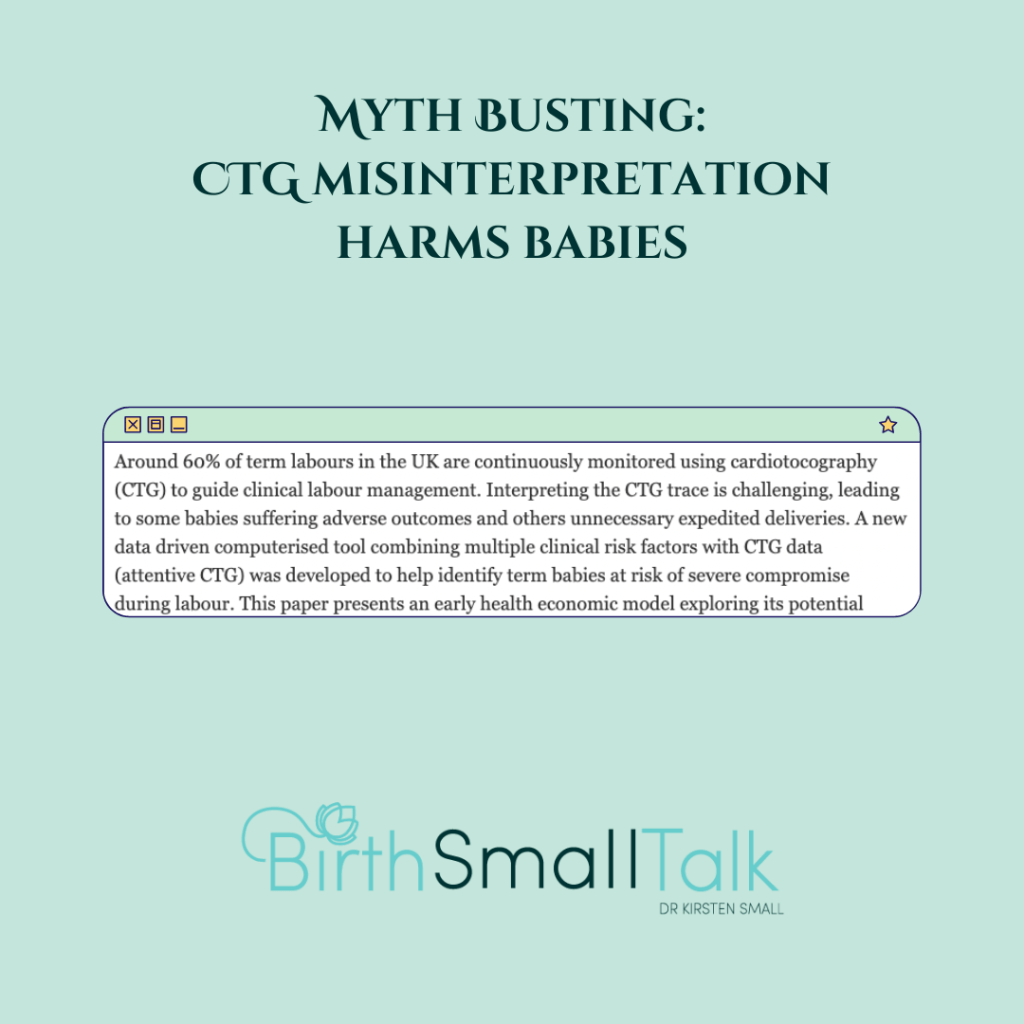
Around 60% of term labours in the UK are continuously monitored using cardiotocography (CTG) to guide clinical labour management. Interpreting the CTG is challenging, leading to some babies suffering adverse outcomes and others unnecessary expedited deliveries. A new data driven computerised tool combining multiple clinical risk factors with CTG data (attentive CTG) was developed to help identify term babies at risk of severe compromise during labour.
Take a moment to think about what you just read. Can you spot anything that makes you uneasy as it might not quite be factual? When you have made up your mind, read on!
Women and fetuses, not labours, are monitored
The first thing that caught my eye was the idea that “labours” are the thing that is being monitored here. If that were true, then why is the other name for the use of the CTG machine “fetal monitoring” and not “labour monitoring”? CTG sensors are applied to a woman’s body – not to a “labour”. They record the heart rate pattern of the fetus – not a “labour”. And the goal is to improve outcomes for the fetus – not for the “labour”.
Women get written out of maternity care far too often. They become pregnancies, births, or in this case labours. This dehumanises and acts to reinforce disrespect to women. You don’t need to bother with troublesome concepts like bodily autonomy and informed consent to do things to a “labour”.
And I covered the idea that “continuous” CTG monitoring is a misnomer last week.
What would I write instead? “Around 60% of women who labour at term in the UK are monitored using a CTG to guide clinical labour management.”
Misinterpretation of the CTG leads babies to suffer from adverse outcomes
The writers imply that misinterpreting the CTG leads to “some babies suffering adverse outcomes”. This is a harder myth to spot and some of you are currently possibly thinking I have lost my mind to call this a myth. I know this is a controversial opinion, so let me explain.
For starters, the underlying pathological process that causes the kinds of adverse outcomes that fetal heart rate monitoring was designed to prevent is low oxygen levels. Or in other words, the cause of adverse outcomes is fetal hypoxia. Not interpreting the CTG correctly (or at all, or not using one) does not cause poor fetal outcomes. Low oxygen levels is the cause.
You might then argue that a correctly interpreted CTG recording can prevent fetuses with low oxygen levels from experiencing more harm, and therefore prevent poor outcomes that are due to low oxygen. That is the theoretical basis on which all forms of fetal heart rate monitoring exist. But no one has ever proven that using fetal heart rate monitoring means fewer babies experience a poor outcome. There is also no really good quality proof that using a CTG rather than intermittent auscultation means fewer babies experience a poor outcome, or that “continuous” CTG use prevents more poor outcomes than intermittent CTG use.
Making a correct interpretation of tarot cards has also never been proven to prevent adverse outcomes for babies from low oxygen levels. If the sentence read “Interpreting the tarot is challenging, leading to some babies suffering adverse outcomes” – then you would immediately spot this as a nonsense statement. It is only because of the annoyingly persistent belief that CTGs work, that when you swap CTG for tarot, people struggle to see that the sentence is still not true.
What would I write instead? “CTG interpretation is challenging, with no evidence that any particular interpretive framework can successfully reduce the risk of a poor outcome.”
Misinterpretation of the CTG leads babies to experience unnecessary expedited deliveries
This one is half of a myth. I can’t think of any research that actually proves that incorrect CTG interpretation is associated with a high rate of use of caesarean section or instrumental birth. What we do have however, is a large and pretty robust body of evidence showing that CTG use (regardless of whether someone might agree that the recording was correctly categorised or not) is linked to higher rates of caesarean section and instrumental birth and lower rates of non-instrumental vaginal birth.
What the statement in the original text implies is that if people were smarter and did a better job of interpreting the CTG, then suddenly the additional caesarean sections and instrumental births would stop. Understanding fetal physiology reveals why this can’t possibly be true. Most “abnormal” heart rate patterns are due to successful fetal attempts to prevent harm when oxygen levels are low. The exact same patterns can also indicate that the fetus is no longer able to adjust and harm is now happening. Faced with an abnormal pattern, the care provider simply cannot tell if expediting birth is necessary or unnecessary. No matter how good people get at interpreting the CTG, this fact will always remain true, and more caesareans and instrumental births than are useful will continue to be done.
Closely tied to this is the belief that the people who were interpreting CTGs “back then”, when the trials comparing CTGs with intermittent auscultation were done, were a bit stupid and didn’t know as much as we know about how to interpret a CTG today. That is why the caesarean section and instrumental birth rates were higher in the studies but we have fixed it now, because everyone is smarter now (they say). This is a form of chronological snobbery, a recognised cognitive bias. There’s no reason to think that people are better or worse at CTG interpretation now than they were at a previous time.
What would I write instead? “CTG interpretation is challenging, with no evidence that any particular interpretive framework can successfully reduce the risk of a poor outcome. Higher rates of caesarean section and instrumental birth are more common with CTG use.”
Babies experience a thing called fetal compromise in labour and the CTG can predict the risk of this happening
Fetal compromise, or fetal distress, is the concept that there is a thing that the fetus experiences when oxygen levels fall low enough to start to cause harm. The main difference between the two terms is that “distress” implies a really awful experience, while compromise is a bit less dramatic.
Coming back to physiology, what happens when oxygen levels fall is that the fetus has REALLY robust systems that kick in to stop harm from happening. Reducing the heart rate is one of these. The heart uses less oxygen per minute it it contracts fewer times per minute. I call this fetal coping. It is clearly a very good thing and not to be considered a compromise or distressing.
In the presence of ongoing low oxygen levels, fetal coping can keep going for a long time. At some point (and this differs for each individual fetus) the ability to cope begins to fail and harm starts to happen. This is fetal decompensation. I don’t find the term fetal compromise all that useful as it doesn’t clearly distinguish between coping and decompensation. And it seems to me that it implies that fetus is not trying hard enough – it made a compromise and is letting down its side of the bargain. Physiologically this is nonsense, as the fetus continues to do everything it can to cope right up to the point where all physical possibilities have been exceeded.
For fetal heart rate monitoring, the tricky thing (as I explained above) is that the heart rate pattern seen with coping is identical to what is seen with decompensation. And the relationship between heart rate patterns and the risk of a poor outcome is not strong enough to be all that useful clinically.
What would I write instead? “A new tool was developed to help improve the consistency of CTG interpretation, and to ensure a comprehensive risk assessment is conducted and the outcome of this assessment is considered when making clinical decisions.”
My request of you
As I wrote last week: No matter who you are and whether you are writing or speaking, please think about the language you are using when you talk about fetal heart rate monitoring. Make sure you aren’t perpetuating the same myths that I have drawn attention to today. Women and fetuses have CTG monitoring, not labours. Incorrect interpretation of the CTG isn’t what causes poor outcomes and there’s no evidence that the rise in caesarean sections and instrumental births can be avoided by “better” interpretation. Fetal compromise probably isn’t a real entity and the risk of poor outcomes is poorly predicted by the CTG.
Join me again next week as I finish this myth busting session. I’m tempted to do this again at a future point in time. Have you seen any in peer-reviewed literature or guidelines that you would love me to blog about? Get in touch!
Sign Up for the BirthSmallTalk Newsletter and Stay Informed!
Want to stay up-to-date with the latest research and course offers? Our monthly newsletter is here to keep you in the loop.
By subscribing to the newsletter, you’ll gain exclusive access to:
- Exciting Announcements: Be the first to know about upcoming courses. Stay ahead of the curve and grab your spot before anyone else!
- Exclusive Offers and Discounts: As a valued subscriber, you’ll receive special discounts and offers on courses. Don’t miss the chance to save money while investing in your knowledge development.
Join the growing community of BirthSmallTalk folks by signing up for the newsletter today!
Sign up to the Newsletter

Categories: CTG, EFM, Perinatal brain injury, Perinatal mortality, Reflections, Writing
Tags: caesarean section, Fetal compromise, Fetal coping, Fetal decompensation, fetal distress, instrumental birth, Invisible women, Physiology
6 replies ›
Trackbacks
- Myth Busting #3: Fetal monitoring is essential – Birth Small Talk
- Twenty fetal monitoring myths that won’t go away – Birth Small Talk
 Birth Small Talk
Excellent.
Line 2 of quotation in the text should say ‘monitored’ not ‘monitoring’.
Catherine
Catherine Williams
LikeLike
Fixed. Thank you – you are my most consistent editorial advisor!
LikeLike
superb
Susan
LikeLike
Thank you xxx
LikeLike